



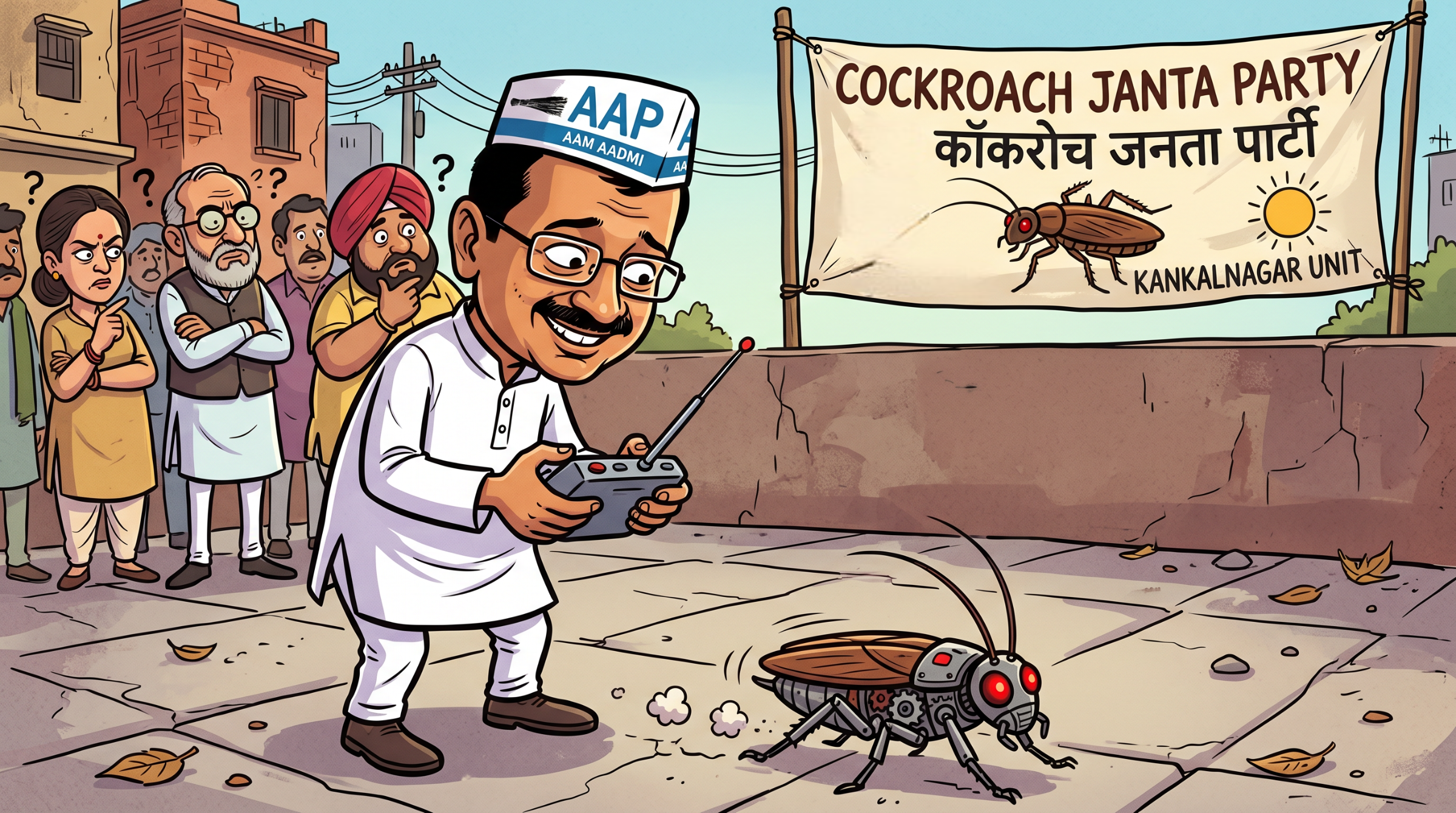
The Indian digital landscape has witnessed some spectacular viral phenomena, but none quite like the meteoric rise of the Cockroach Janta Party (CJP). Born out of internet meme culture in mid-May 2026, the movement branded itself as an apolitical, satirical collective representing the “lazy and unemployed” Gen Z youth of India. In less than a week, its Instagram handle ballooned past 20 million followers, eclipsing the digital footprint of mainstream political behemoths like the Bharatiya Janata Party (BJP).
However, as the CJP prepares to transition from online rants to high-stakes street agitations on June 6, 2026, the illusion of a spontaneous, leaderless student rebellion is quickly unraveling. While the underlying anger regarding national exam irregularities—such as NEET, CUET, and CBSE controversies—is entirely genuine, a deep dive into the factual architecture of the CJP reveals a highly sophisticated campaign.
Is the Cockroach Janta Party (CJP) a legitimate pressure valve for frustrated students, or is it an astroturfed proxy operation designed to mimic recent South Asian youth-led collapses? Let’s unpack the hard facts.
The Foundation Built on a Distorted Judicial Narrative
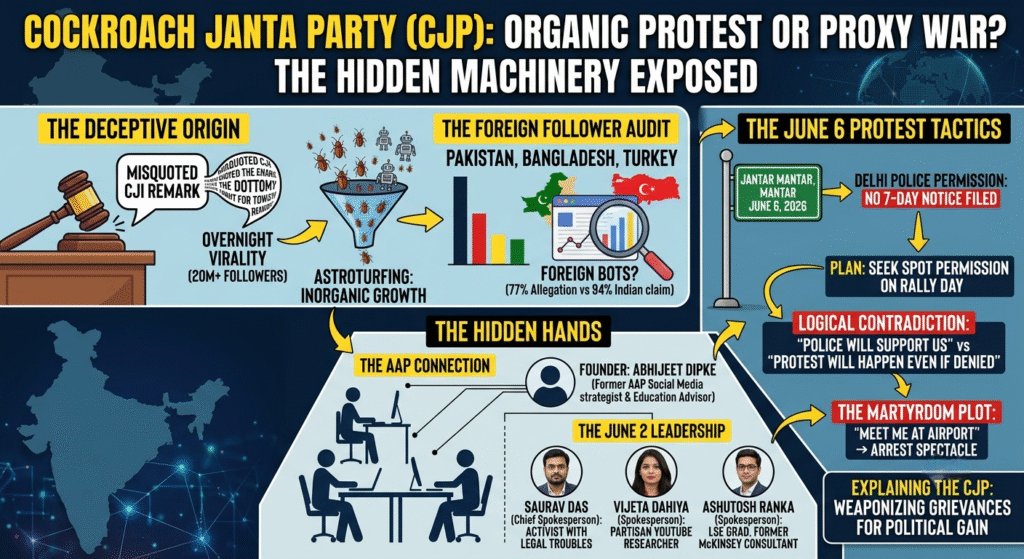
The foundational myth of the Cockroach Janta Party (CJP) relies heavily on a controversial courtroom statement. The movement claimed it was formed as a retaliatory strike after the Chief Justice of India (CJI), Surya Kant, allegedly compared India’s unemployed youth to “cockroaches” and “parasites of society” during a hearing on May 15, 2026.
However, judicial records paint a completely different picture:
The Official Clarification: On May 16, 2026, the Chief Justice explicitly clarified that his oral observations were completely misquoted and taken out of context by sections of the media.
The Real Target: The CJI specified that his sharp criticisms were directed solely at corrupt individuals entering professional legal bodies using entirely bogus and fake degrees. He was not referring to the country’s law-abiding, unemployed youth.
Despite this immediate clarification, the organizers of the CJP chose to ignore the facts, weaponizing the distorted quote to fuel overnight outrage and anchor their brand.
The Analytics Warfare: Where Did 20 Million Followers Come From?
Amassing 20 million social media followers within days is statistically unprecedented for an independent grassroots movement. This unnatural growth rate quickly attracted the attention of digital forensic analysts and government officials, triggering an intense geopolitical debate over the true origin of the CJP’s audience.
The data remains a highly contested battlefield:
The Cross-Border Allegations: Senior union ministers, citing public social media audits and analytical tracking, alleged that a substantial portion of the CJP’s sudden digital footprint originated outside India. Critics pointed to metrics suggesting that up to 49% to 77% of the incoming traffic and engagement emerged from networks based in Pakistan, Bangladesh, and Turkey, sparking national security concerns regarding foreign bot manipulation.
The Founder’s Counter-Claim: In response, CJP founder Abhijeet Dipke published a screen recording of his Instagram analytics dashboard on X. His data claimed that 94.1% of the audience was strictly domestic, with minor fractions coming from the US (1%), the UK (0.7%), and Canada (0.6%).
Without an independent third-party audit from Meta, the sudden influx of millions of anonymous profiles leaves a cloud of suspicion. The anomalies were severe enough that the Ministry of Electronics and Information Technology (MeitY) invoked Section 69(A) of the IT Act to restrict the party’s account within India on national security grounds—a block that the Delhi High Court subsequently refused to lift in an urgent appeal.
Unmasking the AAP Machinery Behind the "Apolitical" Mask
The CJP has repeatedly insisted that it has no interest in traditional politics. Yet, the mastermind behind the curtain is a highly trained political communications professional.
Founder Abhijeet Dipke is a digital strategist with deep, undeniable ties to the Aam Aadmi Party (AAP):
The Core Experience: Dipke spent years (2020–2023) operating within the AAP social media core team. He was actively involved in executing the meme-based digital campaigns during the 2020 Delhi Assembly elections.
The Insider Role: Dipke subsequently worked as a communications advisor for the Delhi Government’s Education Department under former Deputy Chief Minister Manish Sisodia, whom he has publicly credited as a mentor.
An operative with years of experience building partisan political narratives designed an “apolitical” movement using advanced AI tools.
The Institutional Shift: The June 3 Press Conference Escalation
The transition of the Cockroach Janta Party (CJP) from a satirical internet page to a structured political entity became official on June 3, 2026. The group held its first-ever high-profile, physical press conference at the Deputy Speaker Hall in the Constitution Club of India, New Delhi.
The conference room ran out of seating almost immediately, packed with mainstream media correspondents eager to see who was pulling the strings. It was here that the CJP formally unveiled its newly appointed administrative communication team. The backgrounds of these appointees further dismantle the narrative of an ordinary, leaderless student collective:
Saurav Das (Chief Spokesperson): Far from an average student, Das is an investigative journalist and activist who previously fronted highly polarized anti-pollution protests at India Gate in November 2025. Notably, the Delhi High Court had recently issued him a notice alongside senior AAP leader Gopal Rai regarding contempt proceedings over an alleged orchestrated social media campaign against a sitting High Court judge.
Vijeta Dahiya (Official Spokesperson): A political researcher, author, and filmmaker who has generated direct research and content for highly partisan political YouTube channels, including networks intimately linked to Dhruv Rathee.
Ashutosh Ranka (Official Spokesperson): An IIT Kanpur and London School of Economics alumnus, and a former management consultant for global corporate firm McKinsey & Company.
When journalists grilled the trio on their clear, pre-existing political alignments and deep organizational histories with opposition factions, spokesperson Ashutosh Ranka brushed it aside, stating that their “past affiliation is not important” and asking the public not to reduce a national movement to individual histories.
The South Asian Playbook: Mirroring Bangladesh, Nepal, and Sri Lanka
When you strip away the internet memes, the structural trajectory of the Cockroach Janta Party (CJP) reveals a highly concerning geopolitical pattern. The movement appears to be a calculated attempt to replicate the exact “Gen Z regime-change” playbooks that recently triggered severe institutional collapses across South Asia—specifically in Bangladesh, Nepal, and Sri Lanka.
In those countries, the operations followed a strict, identical three-step blueprint:
Front-Load Valid Grievances: Find an explosive, deeply emotional institutional crisis that genuinely affects millions of young people—whether it is a government job quota system or, in India’s case, national exam paper leaks (NEET, CUET, CBSE). Because the student anger is legitimate, it provides the perfect moral shield.
Manufacture Astroturfed Scale: Use professional PR machinery, coordinated digital influencers, and algorithm manipulation to create an illusion of overwhelming, leaderless consensus, completely bypassing traditional, peaceful dialogue.
Escalate to Street Disruption: Shift immediately from digital spaces to aggressive on-ground mobilization, demanding immediate, high-level political resignations (like the CJP’s demand for the Education Minister’s exit) while refusing to cooperate with standard state guidelines.
By systematically shifting from online satire to targeted street confrontation, the CJP isn’t trying to fix the examination system—it is trying to test a foreign blueprint of manufactured civil unrest on Indian soil, using frustrated students as ideological human shields.
Bypassing the Law: The Procedural Defiance and Logical Contradictions
The most explosive moment of the June 3 press conference occurred when investigative reporters exposed a massive legal and logical contradiction in the CJP’s street strategy.
Under explicit Delhi Police regulations and judicial mandates, holding any large-scale physical demonstration or dharna in high-security zones like New Delhi requires a mandatory 7-day advance notice and written permission. This is a prerequisite to ensure public safety, manage massive traffic routes, and prevent urban chaos.
When journalists pressed the panel on why they had completely ignored this legal requirement before calling thousands of young students to march on the streets, the exchange laid bare a bizarre double standard:
The Media’s Question: Why didn’t you wait for the mandatory legal permission from the Delhi Police before calling thousands of youth to the streets?
The CJP’s Admission: The spokespersons admitted they chose not to apply in advance because they are fundamentally “against the way protest permits are given in this country,” confidently assuming the police would never approve it anyway. Instead, they revealed a highly irregular plan: founder Abhijeet Dipke will land on Saturday morning, June 6, and only then will they walk into the Parliament Street Police Station to demand spot permission on the exact day of the rally.
The Ultimate Contradiction: When a reporter followed up, asking what they would do if the police stopped them due to the total lack of advance legal permits, Chief Spokesperson Saurav Das bizarrely claimed, “We have full confidence in the Delhi Police that permission will be provided… because these exam leaks affect their children too.” Yet, in the very same breath, the leadership defiantly stated that the protest will aggressively move forward at Jantar Mantar even if the Delhi Police explicitly denies them permission. This reveals a dangerous, manufactured trap: they are intentionally setting up a scenario where they bypass the law, claim the police will support them, but actively prepare to violate public order the moment law enforcement does its job.
The June 6 Protest Playbook: Engineering a Political Martyr?
The CJP has called for a massive physical mobilization on Saturday, June 6, 2026, demanding the immediate resignation of Union Education Minister Dharmendra Pradhan. The group dismissed the government’s recent transfer of senior CBSE officials as a mere “eyewash,” pushing instead for absolute escalation.
The logistics surrounding this protest follow a highly specific tactical blueprint. Founder Abhijeet Dipke is scheduled to land at the New Delhi airport at 8:00 AM on June 6, flying in from Boston. While viral social media compliance reports suggest that Dipke is returning due to forced deportation issues from the United States, the CJP digital machinery has flipped the narrative into voluntary political martyrdom.
Dipke released a video address urging thousands of students to swarm the airport to meet him, explicitly anticipating his immediate arrest upon landing to create an instant national media spectacle. Furthermore, the CJP has announced its intention to proceed with a two-day dharna at Jantar Mantar alongside veteran anti-government figures like Sonam Wangchuk (who explicitly extended his support and labeled himself an “honorary cockroach”) and actor Prakash Raj, ensuring that mainstream political activists remain at the center of the frame.
Separating Justified Student Anger from Political Traps
There is no denying that the systemic vulnerabilities, marking controversies, and paper leaks plaguing national competitive exams are real. India’s Gen Z youth have every right to be angry, and their demands for absolute institutional transparency are entirely legitimate.
However, a critical analysis of the Cockroach Janta Party (CJP) indicates that this platform is far from an innocent, leaderless student union. From its origin story based on a distorted judicial quote to its leadership packed with veteran partisan strategists, the CJP functions as a highly sophisticated proxy tool. By adopting a disruptive street strategy on June 6 that intentionally flouts mandatory policing laws and sets up a contradictory trap for law enforcement, the CJP risks weaponizing genuine student anxiety.
We must wait for June 6 to see what truly uncovers at the Delhi airport and Jantar Mantar. Will this unfold as a genuine, peaceful attempt to safeguard the future of India’s children? Or will the events reveal a far more sinister blueprint—a carefully engineered trap orchestrated by a Western deep state looking to destabilize India’s internal security through proxy chaos? The actions on the ground will speak louder than any internet meme. India’s youth must remain vigilant and ensure their legitimate fight for educational reform is not co-opted by hidden puppet masters.