




In the hyper-accelerated digital landscape of 2026, we are witnessing a global crisis of perspective. From quarterly corporate earnings to the dopamine-fueled metrics of social media, our collective focus has shrunk to the immediate horizon. This phenomenon has created a dangerous vacuum where long-term strategy used to live. We are currently caught in the instant results trap, a cycle where the pressure for immediate validation is actively eroding our capacity for sustainable growth and legacy building.
Understanding why we are biologically and structurally wired to prefer the “quick fix” over the “long game” is the first step toward reclaiming our future. This deep dive explores the gritty reality of why short-term thinking dominates our world and how the most successful leaders are learning to break free.
1. The Neurobiology of the "Now"
The most powerful driver of the instant results trap is located between our ears. Evolutionarily, humans are wired for immediate survival. In the savannah, a calorie found today was worth more than a feast promised next month. Our brains reward immediate completion with a surge of dopamine—the “feel-good” neurotransmitter.
In 2026, this ancient survival mechanism is being hijacked by technology. Every “like,” every notification, and every “cleared” task list provides a micro-dose of dopamine. This creates a feedback loop that trains us to prioritize low-value, high-speed tasks. When we fall into the instant results trap, we become addicted to the “check-mark” rather than the “breakthrough.” Deep, long-term work doesn’t offer that same immediate chemical reward, making it feel “boring” or “unproductive” by comparison.
2. Quarterly Capitalism: The Institutional Enforcer
In the professional sphere, the instant results trap is not just a personal habit; it is a corporate mandate. Publicly traded companies are legally and structurally beholden to quarterly earnings reports. A CEO who chooses to invest in a five-year infrastructure project that might temporarily dip the current stock price often faces shareholder revolts or removal.
This “quarterly thinking” forces organizations to cannibalize their future to feed their present. We see this in reduced R&D budgets, the slashing of employee training programs, and the postponement of essential maintenance. The reality is that many “market leaders” are currently hollowed-out shells, trading long-term resilience for a temporary green candle on a trading screen.
3. The Social Comparison Engine
We no longer measure our progress against our own past; we measure it against the global “highlight reel” of the internet. When we see a peer’s “overnight” success or a competitor’s viral expansion, we feel a sense of “time-poverty.” We feel we are falling behind a schedule that doesn’t actually exist.
This anxiety leads us directly into the instant results trap. We stop looking for sustainable paths and start looking for “hacks,” “blueprints,” and “shortcuts.” We want the 30-day body transformation or the “zero-to-one-million” business strategy. By chasing these mirages, we often end up exhausted and further away from our goals than when we started. We forget that the “overnight success” we admire was almost always ten years in the making.
4. Extreme Optimization and the Loss of "Slack"
Modern management focuses on “lean” operations and extreme efficiency. However, there is a hidden cost to optimizing for the short term. When you remove all “slack” from a system to increase immediate profit, you remove the system’s ability to innovate or survive a crisis.
A business caught in the instant results trap might automate its entire customer service department to save $500,000 this month. On the balance sheet, it looks like a win. In the reality of the market, the brand’s human connection—the very thing that creates customer lifetime value—evaporates. Short-term optimization often leads to long-term fragility.
5. Decision Fatigue: The Path of Least Resistance
Thinking about the year 2035 is cognitively expensive. It requires us to simulate multiple futures, weigh complex risks, and maintain a vision through periods of zero external feedback. In a world of infinite information, we are suffering from chronic decision fatigue.
When the brain is tired, it defaults to the path of least resistance. The instant results trap is that path. It is easier to react to an email than to write a strategy. It is easier to fix a symptom than to cure a disease. Breaking this cycle requires more than just willpower; it requires a structural redesign of how we protect our mental energy.
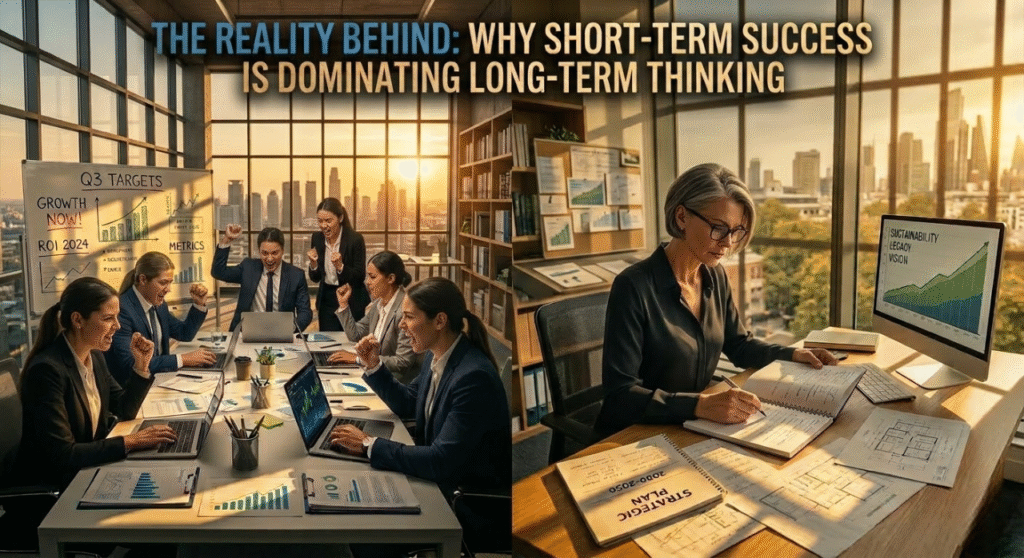
6. The Survival Mode Paradox
There is a cruel irony in how we handle instability. During times of global economic or technological shift, our instinct is to hunker down and focus on the next 24 hours. While tactical awareness is necessary, staying in “survival mode” for too long is a death sentence for a career or a company.
The instant results trap makes us feel safe because we are “doing things.” But if those things aren’t aligned with a North Star, we are simply running in place while the landscape shifts beneath us. Those who thrive during disruption are the ones who can pivot their tactics while keeping their long-term vision locked in place.
7. The Competitive Advantage of the Long Game
As the world moves toward shorter content and faster results, the “long game” becomes a wide-open market. If everyone else is playing a one-week game, the individual or company playing a ten-year game has virtually no competition.
Escaping the instant results trap is the ultimate “blue ocean” strategy. True wealth—intellectual, financial, and relational—compounds over time. By opting out of the scramble for today’s crumbs, you position yourself to own the entire bakery a decade from now.
The Strategy Matrix: Escaping the Trap
| Factor | The Instant Results Trap (Short-Term) | The Legacy Mindset (Long-Term) |
| Primary Driver | External Validation / Fear | Internal Vision / Purpose |
| Success Metric | High Volume / High Speed | High Impact / High Value |
| Risk Handling | Avoids risk, creating fragility | Manages risk, creating resilience |
| Sustainability | Leads to Burnout | Leads to Mastery |
8. Practical Steps: The 70/20/10 Framework
How do you survive today while building for tomorrow? You must become “bilingual” in your strategy.
70% Focus (The Now): Execute your current tasks with excellence to keep the lights on.
20% Focus (The Near): Invest in emerging skills or projects that will pay off in 12–24 months.
10% Focus (The Next): Dedicate time to “moonshots”—radical ideas or deep learning that won’t show results for 5+ years. By diversifying your time, you ensure you don’t fall entirely into the instant results trap.
9. Re-parenting Your Dopamine Response
To win the long game, you must learn to “gamify” the process rather than the outcome. If you only feel good when the project is finished, you will succumb to the instant results trap. If you can learn to feel a sense of achievement in the act of deep work itself, you become unstoppable.
The goal is to shift your dopamine reward from the “Result” to the “Routine.” When the routine becomes the reward, the long-term results become an inevitable byproduct.
The Legacy Choice
The reality behind why short-term success dominates is that it appeals to our most primal, fearful instincts. But great leadership is about moving beyond instinct. It is about the courage to be misunderstood in the short term so that you can be legendary in the long term.
The instant results trap promises safety and speed, but it delivers stagnation. Choosing the long-term path is undeniably harder at the start, but it is the only path that leads to a life of true significance. Don’t trade your legacy for a temporary “Like.”