


In the fast-paced, hyper-connected landscape of 2026, the traditional concept of “Work-Life Balance” has officially retired. We are no longer living in a world where a simple 9-to-5 schedule exists, nor is there a clear-cut “off” switch. As an Indian professional, whether you are navigating the high-pressure tech corridors of Bengaluru, the financial hubs of Mumbai, or the creative agencies of Delhi, you’ve likely felt it: the lines have blurred beyond recognition. Achieving modern work-life harmony has become the ultimate challenge of the mid-2020s.
The Great Shift: From Balance to Integration
The word “balance” implies a seesaw—two distinct sides competing for your time. If you give more to one, the other suffers. However, the reality of 2026 is much more fluid. We are in the era of “Work-Life Integration.”
But why is this so hard to define? Because the definitions are now individual. For a young developer, modern work-life harmony might mean working 12-hour days for four days and taking a three-day weekend. For a working parent, it might mean taking a four-hour break in the afternoon for school runs and logging back on at 9 PM. Because there is no longer a standard “rulebook,” many feel lost at sea, constantly working but never feeling “done.”
1. The Death of the Physical Boundary
Historically, the physical act of “going to work” provided a psychological ritual. The commute—no matter how grueling the traffic in Bangalore or the crowds in the Mumbai locals—acted as a “decompression chamber.” It was a transition period where the brain shifted from “Home Mode” to “Work Mode.”
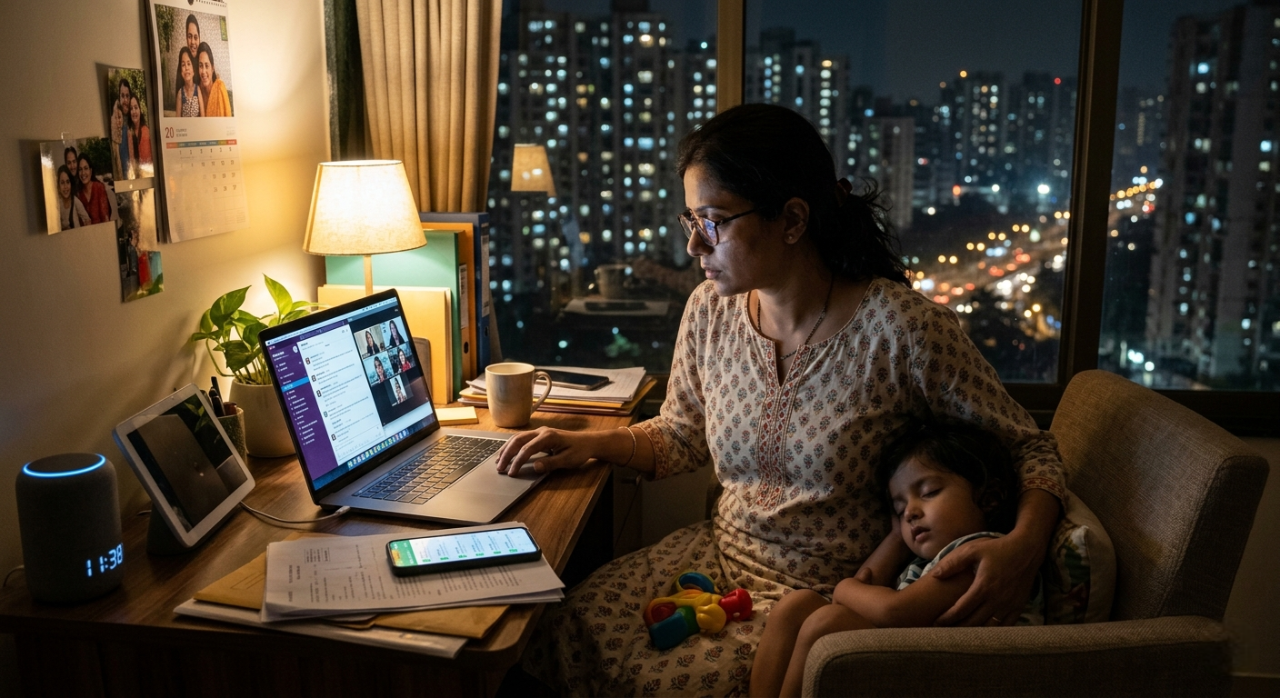
With the permanent rise of hybrid and remote models in 2026, those walls have crumbled. Your kitchen table is your boardroom; your bedroom is your focus zone. When your workspace is only three feet from your bed, the brain struggles to flip the “off” switch. This lack of physical separation is a primary reason modern work-life harmony is so elusive—we are physically home, but mentally we never left the office. We are living in our offices rather than working from our homes.
2. The WhatsApp Trap and the "Always-On" Culture
India has the highest professional usage of instant messaging apps in the world. In 2026, the formal “email era” has taken a backseat to the “ping era.” Because these apps are installed on our personal devices, work notifications sit right next to a message from your mother or a photo in a friends’ group.
This creates a state of “continuous partial attention.” Even when you are at a family dinner, a part of your brain is subconsciously bracing for the next notification. This “digital leash” makes it impossible to truly disconnect. To achieve modern work-life harmony, one must possess an incredible amount of digital discipline—something our current app ecosystems are designed to undermine with their addictive notification loops.
3. The "Side-Hustle" and the Passion Economy
In the current Indian economic climate, relying on a single paycheck is often seen as risky. The rise of the “Side-Hustle” has seen professionals becoming weekend consultants, YouTubers, or e-commerce entrepreneurs. While this provides financial security and creative fulfillment, it eats into the “Life” portion of the balance.
When your “passion project” takes up your Saturday and Sunday, when do you actually rest? For the ambitious Indian millennial, modern work-life harmony is often sacrificed for the sake of “hustle culture.” The pressure to be productive 24/7 has turned hobbies into businesses, leaving no room for unproductive, restorative play.
4. The Flexibility Paradox
Ironically, the very flexibility we fought for during the early 2020s is what’s making us more stressed in 2026. Many Indian firms now offer “unlimited” PTO (Paid Time Off) or flexible “output-based” hours. However, data shows that employees with these perks often work more hours than those on a fixed clock.
This is known as the “Guilt of Flexibility.” To prove they aren’t slacking off while working from a cafe or their living room, employees overcompensate. They reply to messages at 11 PM or start their day at 6 AM. The definition of modern work-life harmony becomes warped when flexibility is viewed as an invitation for work to seep into every available crevice of your personal life.
5. Cultural Expectations and the "Hardest Worker" Trophy
In India, there is a deep-seated cultural pride in “toiling.” We are raised with the stories of ancestors who worked 18-hour days to build a future. In the corporate world, this has evolved into “presenteeism”—the need to be seen as the most dedicated person in the room (or the Zoom call).
Even as Gen Z pushes for better mental health awareness, the ghost of the “overworked hero” remains. When organizational leadership rewards the person who answers an email during their sister’s wedding, it sends a clear signal: modern work-life harmony is a secondary priority. Until the “trophy for overworking” is retired, defining a healthy balance will remain a struggle for the average employee.
6. The Psychological Toll of "Micro-Tasking"
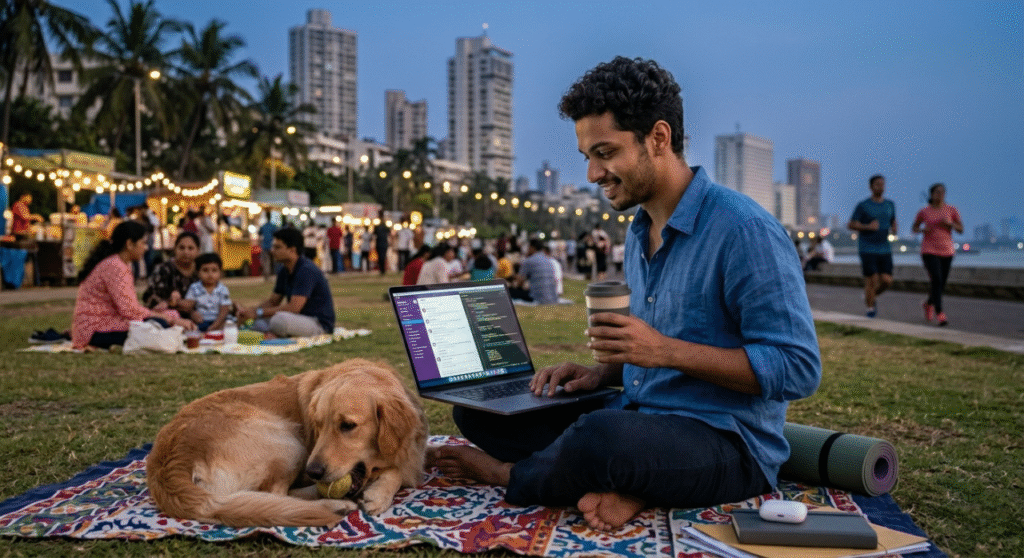
In 2026, work is no longer a monolith. It’s a series of micro-tasks spread across the day. You check an email while waiting for the microwave; you review a deck while your child is at swim practice. This “fragmentation of time” means that even though you might only work 8 hours in total, those hours are spread across a 16-hour window.
This prevents the brain from entering “Deep Rest.” Without long, uninterrupted blocks of personal time, the nervous system remains in a state of low-level “fight or flight.” This is why, despite having more “flexible” jobs, many Indians report feeling more burnt out than ever before. Modern work-life harmony requires us to reclaim blocks of time, not just minutes.
7. The Role of AI: Hero or Villain?
The integration of AI in 2026 was supposed to save us time. In many ways, it has. AI agents now handle our scheduling, summarize long meetings, and even draft our basic reports. However, the “Jevons Paradox” suggests that when a resource becomes more efficient, we just use more of it.
Instead of using the two hours saved by AI to go for a walk or play with our kids, we fill those two hours with more work. AI has increased the velocity of business, meaning we are expected to produce more, faster. Redefining modern work-life harmony in the age of AI means consciously choosing to use saved time for personal recovery rather than additional output.
8. The Impact on the Indian Family Structure
The shift in work dynamics is also changing the Indian home. Traditionally, the “Joint Family” provided a support system that allowed for a division of labor. As we move toward more nuclear setups in urban centers, the pressure on a working couple is immense.
Without the “village” to help with childcare or household management, and with work demands increasing, the “Life” side of the equation is under heavy fire. For these families, modern work-life harmony isn’t just about time management; it’s about logistical survival.
9. How to Reclaim Your Harmony in 2026
So, how do we define and achieve this elusive state? It requires a move from passive boundary-setting to active “Boundary Design.”
The 3D Rule (Digital, Distance, Disconnect): Create a “Digital Sunset” where all work devices are put in a literal box at a certain hour. Use “Distance” by working in a specific chair or room, and “Disconnect” by informing colleagues of your “Blackout Hours.”
Communication Contracts: We need to move away from the assumption of “Immediate Response.” Establishing a contract with your team—where “urgent” means a phone call and “standard” means an email—can restore modern work-life harmony.
Prioritizing ‘Soft’ Productivity: Recognize that sleep, exercise, and boredom are actually productive activities. They “sharpen the saw.”
A Personalized Future
We cannot return to the 1990s. The world is too connected, and the global economy moves too fast. The reason modern work-life harmony is harder to define is that it has become a personal responsibility rather than a corporate policy.
As we move through 2026, the most successful professionals won’t be those who work the most, but those who manage their energy the best. Success is being redefined. It is no longer just about the CTC (Cost to Company) or the job title; it is about the “Quality of Life” index.
True modern work-life harmony is the ability to be fully present wherever you are—at your desk during the day, and with your loved ones at night. It is not a destination you reach, but a practice you maintain every single day. By setting our own definitions, we can stop chasing an impossible “balance” and start living a harmonious, integrated life.