



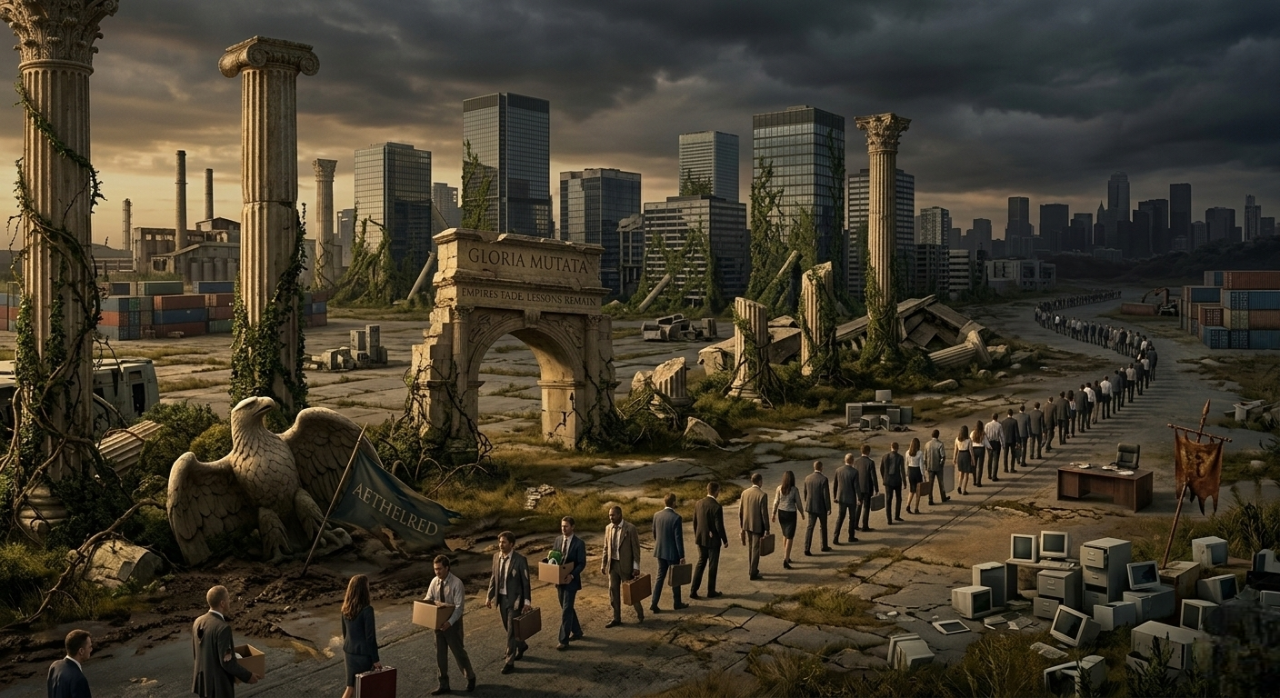
History is not merely a collection of dates and dusty relics; it is a blueprint. When we study the fall of Rome, the fragmentation of the Mongol Empire, or the slow sunset of the British Raj, we aren’t just looking at the past—we are looking at a mirror. The same systemic rot that toppled the Caesars is currently at work in many of today’s Fortune 500 companies. Understanding Why Great Empires Collapse: A Lesson for Modern Organizations is no longer an academic exercise; it is a survival requirement for any leader operating in the volatile landscape of 2026.
At Radio Platonic, we look for the “True North” by examining the intersection of historical cycles and modern business strategy. If your organization feels invincible today, remember that every fallen empire once felt the same. Here is the post-mortem of history, and how you can avoid becoming a corporate ruin.
1. The Trap of Imperial Overstretch
One of the most frequent reasons Why Great Empires Collapse: A Lesson for Modern Organizations is the phenomenon of overstretch. Whether it was the Roman Empire attempting to defend frontiers spanning from Britain to the Euphrates, or a modern tech giant trying to dominate ten different industries simultaneously, the result is the same: resource depletion.
When an organization expands its “borders” faster than its internal infrastructure can support, the center cannot hold. Strategic focus is traded for sheer scale. In the corporate world, this manifests as “diworseification”—buying up companies that don’t fit the core mission just to show growth. Eventually, the logistical cost of maintaining the periphery exceeds the value the periphery provides.
2. Bureaucratic Sclerosis and the Death of Agility
As empires age, they stop being governed by vision and start being governed by rules. In late-stage Byzantium, the court rituals became so complex they paralyzed the state. This is exactly Why Great Empires Collapse: A Lesson for Modern Organizations, and it happens in the boardroom every day.
When a company moves from a “founder’s mentality” to a “manager’s mentality,” layers of middle management are added like sedimentary rock. Decision-making slows to a crawl. Innovation is sacrificed on the altar of “process.” When an organization values the filing of a report more than the solving of a customer’s problem, the “Competence Fog” has set in, and the empire is beginning to petrify.
3. The Decoupling of the Elite from Reality
History shows us that Why Great Empires Collapse: A Lesson for Modern Organizations is often due to the “Palace Gap.” In the final days of many dynasties, the ruling class lived in total isolation from the struggles of the common citizen. They made decisions based on curated reports rather than the reality on the ground.
In modern business, this happens when C-suite executives stop talking to frontline employees or customers. They rely on “data dashboards” that can be manipulated to show what they want to see. When the leadership of a company loses touch with the “boots on the ground,” they lose the ability to sense incoming threats. They are rearranging the furniture in the palace while the barbarians are already at the gates.
4. Economic Debasement and Financial Nihilism
Rome didn’t just fall to swords; it fell to inflation. By constantly reducing the silver content in the denarius to pay for rising costs, the state destroyed the trust of its citizens. This economic lesson is central to Why Great Empires Collapse: A Lesson for Modern Organizations.
In a corporate context, “debasement” happens when a company sacrifices the quality of its product or the integrity of its brand to hit short-term stock targets. When you “hollow out” the value of what you offer to pay for the overhead of a bloated structure, you are debasing your currency. Eventually, the market realizes the “coin” is worthless, and the collapse is swift.

5. The Loss of a Shared "True North"
Every great empire began with a shared story—a sense of destiny or purpose that bound people together. When that story dies, the empire becomes nothing more than a collection of individuals looking out for themselves. This internal fragmentation is a core reason Why Great Empires Collapse: A Lesson for Modern Organizations.
When employees no longer believe in the company’s mission, they become mercenaries. They do the bare minimum to get paid. Without a shared “True North,” the organization lacks the collective will to survive a crisis. A company of 10,000 mercenaries will always lose to a “tribe” of 100 people who believe in a common cause.
6. Success as a Precursor to Failure
Ironically, the greatest threat to an empire is often its previous success. Success breeds arrogance, and arrogance breeds the belief that “the old way” will always work. This “Icarus Paradox” is Why Great Empires Collapse: A Lesson for Modern Organizations.
The Ottoman Empire, once the most advanced military power on earth, failed to adapt to the Industrial Revolution because they believed their traditional methods were divinely superior. Modern companies like Kodak or Nokia fell into the same trap. They were so busy celebrating their past victories that they failed to see the world had changed. Success is a “Competence Fog” that blinds you to the need for evolution.
7. Institutional Hubris and the Ignoring of Feedback Loops
Empires fall when they stop listening. Whether it was the Spanish Empire ignoring the warnings of its diminishing gold reserves or a CEO ignoring a “whistleblower,” the pattern is the same. Feedback loops are the “nervous system” of an organization.
Why Great Empires Collapse: A Lesson for Modern Organizations is frequently tied to the silencing of dissent. When “Yes Men” fill the halls of power, the organization loses its ability to self-correct. If your culture punishes people for speaking the truth, you have effectively cut the nerves of your empire. You won’t feel the pain of the fire until the building is already ash.
8. Environmental and Resource Exhaustion
Many ancient civilizations, like the Maya, collapsed because they over-exploited their natural environment. In the modern corporate world, the “environment” is your talent pool and your brand reputation.
Why Great Empires Collapse: A Lesson for Modern Organizations is often a story of burning out the very people who make the organization run. High-performance cultures that treat humans like disposable batteries eventually run out of energy. You cannot sustain an empire on a “scorched earth” HR policy. Eventually, the talent migrates to greener pastures, leaving behind a hollow shell.
9. The Fragmentation of Identity (The Balkanization Effect)
In the later stages of an empire, internal factions begin to fight each other more than they fight external enemies. Departmental silos in a corporation are the modern equivalent of warring provinces.
When Marketing hates Sales, and Product won’t talk to Engineering, the organization is “Balkanized.” Energy is wasted on internal politics rather than external competition. This internal friction is a primary driver of Why Great Empires Collapse: A Lesson for Modern Organizations. An organization divided against itself cannot stand against a unified competitor.
10. Building a "Collapse-Proof" Organization
The lessons of history are clear. To avoid the fate of fallen empires, modern organizations must practice “Directed Evolution.” This means:
Radical Transparency: Killing the “Palace Gap” by staying connected to the reality of the customer.
Strategic Restraint: Avoiding overstretch by focusing on the “True North” mission.
Cultural Integrity: Refusing to debase the brand for short-term gains.
Agility over Ritual: Prioritizing outcomes over bureaucratic process.
At Radio Platonic, we believe that the best way to predict the future is to master the lessons of the past. Why Great Empires Collapse: A Lesson for Modern Organizations is a warning, but it is also an opportunity. By recognizing the signs of “Imperial Decay” early, you can pivot your organization toward a more resilient, symbiotic future.
Don’t let your career or your company become a ruin for future generations to study. Evolve, adapt, and stay true to your mission.