



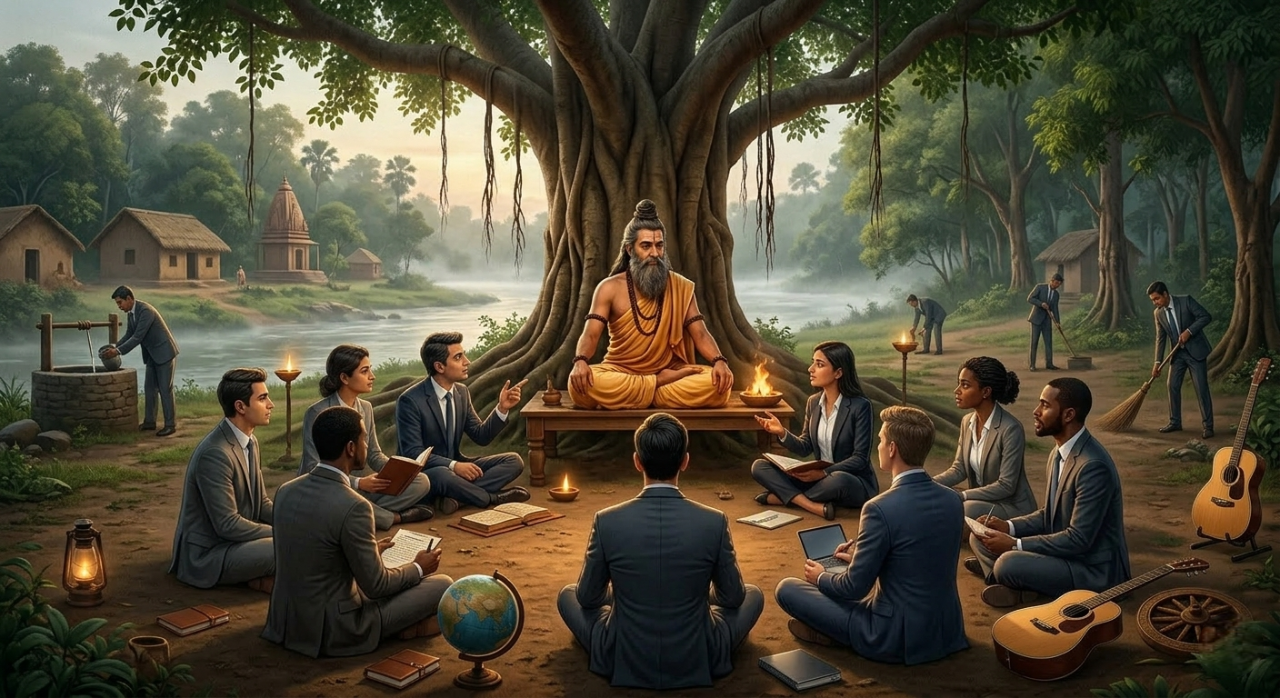
In the modern era of standardized testing, digital distractions, and fragmented learning, we often look back at the past with a sense of wonder. How did a civilization thousands of years ago produce polymaths, philosophers, and scientists whose contributions to mathematics, medicine, and linguistics still stand firm today? The answer lies in the unique pedagogical structure of Ancient Indian Gurukuls.
These were not merely schools; they were crucibles of character. By blending rigorous intellectual exercise with spiritual discipline and practical life skills, the system created a lineage of “Strong Thinkers”—individuals who didn’t just consume information but synthesized wisdom. To understand why this system was so effective, we must deconstruct the layers of its psychological and educational philosophy.
The Living Laboratory: Sensory Engagement and Environment
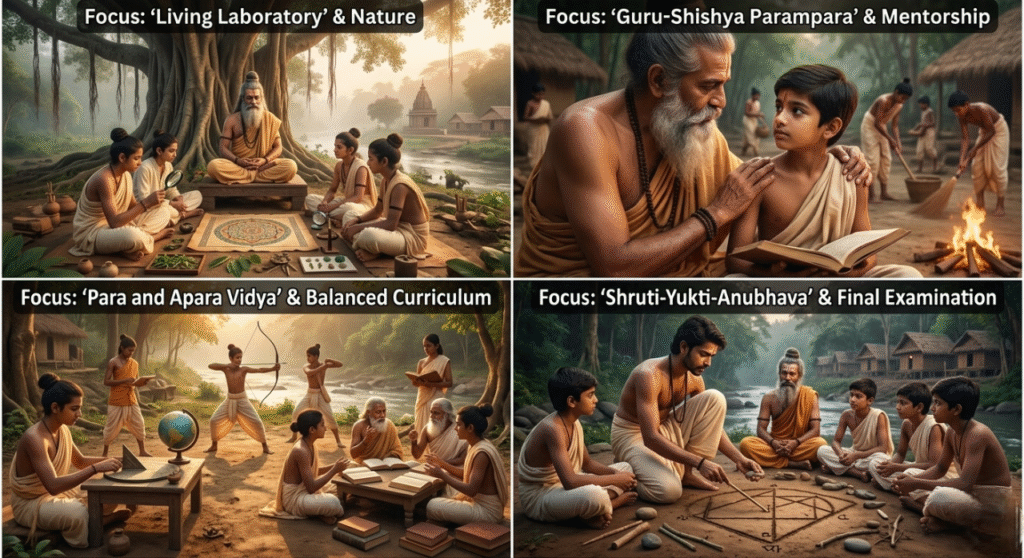
The primary reason Ancient Indian Gurukuls produced such formidable intellects was the environment. Unlike modern classrooms confined by concrete and artificial lighting, Gurukuls were usually situated in Gurukulams or Ashrams within forests (Tapovans) or near riverbanks.
Heightened Sensory Awareness
Learning in nature forced students to be observant. When a student studies biology or botany in the middle of a forest, the knowledge is not theoretical; it is experiential. They observed the patterns of the seasons, the behavior of local fauna, and the medicinal properties of flora in real-time. This immersion fostered an empirical mindset—a fundamental requirement for any “Strong Thinker.”
Minimalist Living and Cognitive Load
By removing the luxuries and distractions of urban life, the student’s mind was freed from “material clutter.” In cognitive science, we call this reducing extraneous cognitive load. With fewer trivial choices to make (what to wear, what entertainment to seek), the brain’s energy was entirely redirected toward deep, uninterrupted focus, known in Sanskrit as Ekagrata.
The Guru-Shishya Parampara: The Gold Standard of Mentorship
At the heart of Ancient Indian Gurukuls was the Guru-Shishya Parampara (Teacher-Disciple tradition). This was not a transactional relationship where a teacher delivered a lecture and left. It was a 24/7 immersive mentorship.
Individualized Curriculum (The “Prakriti” Assessment)
In the Gurukul system, there was no “one size fits all” education. The Guru acted as a psychological profiler, identifying the specific Prakriti (inner nature) and Guna (attributes) of each student. If a student showed a flair for logic, they were guided toward Nyaya (Logic); if they were inclined toward administration and leadership, they studied Arthashastra (Economics/Politics). This ensured that thinkers were operating in their zone of genius, rather than struggling against their natural inclinations.
Character Modeling
Students lived with their teachers. They observed how the Guru handled stress, how they treated guests, and how they maintained their own discipline. Thinking wasn’t just taught through books; it was “caught” through observation. The Guru provided a living blueprint of a disciplined intellect.
The Power of Oral Tradition and Neuroplasticity
Modern critics often mistake the oral tradition of Ancient Indian Gurukuls for simple rote memorization. However, it was a sophisticated exercise in neuroplasticity.
The Vedas and Upanishads were taught using complex mnemonic techniques like Chanda (meter) and Vikriti Patha (permutations of chanting). These methods served two vital purposes:
Expanding Mental Capacity: Constantly memorizing and reciting complex structures expanded the brain’s “working memory.” A student in a Gurukul had to hold vast amounts of data in their head simultaneously to find connections between different verses.
Preserving Information Integrity: Because manuscripts could decay or be burned, the “Strong Thinker” became a living library. They carried their knowledge within them, ensuring it was accessible at any moment without external aids.
Integration of Para and Apara Vidya: The Multi-Disciplinary Mind
The Gurukul system did not compartmentalize “secular” and “sacred” knowledge. They recognized two essential streams:
Apara Vidya: “Lower” or material knowledge (Science, Grammar, Mathematics, Astronomy, Martial Arts, Medicine).
Para Vidya: “Higher” or spiritual knowledge (Philosophy, Self-realization, Ethics, Metaphysics).
By balancing these, Ancient Indian Gurukuls ensured that a scientist was also a philosopher. They understood that logic without ethics is dangerous, and spirituality without logic is superstition. This integration birthed thinkers who could solve complex engineering problems while remaining grounded in a moral compass—a trait sorely needed in the age of AI and bioethics.
The "Shruti-Yukti-Anubhava" Cognitive Framework
How did these students validate what they learned? They followed a three-step cognitive process that modern pedagogy is only now fully appreciating:
Shruti (Hearing/Data Acquisition): Receiving the concept from a trusted source or text.
Yukti (Logic/Reasoning): Subjecting that data to rigorous debate, internal questioning, and logical deconstruction.
Anubhava (Experience/Application): Applying the knowledge in real-life scenarios to see if it holds true.
This framework prevented the “blind following” of dogma. In Ancient Indian Gurukuls, a student was encouraged to debate the Guru, provided the debate was rooted in Tarka (logical reasoning). This fostered a culture of healthy skepticism and intellectual bravery.
The 64 Kalas: Developing the Polymath
Education in Ancient Indian Gurukuls was incredibly diverse. The curriculum often included the 64 Kalas (Arts and Sciences), which ranged from:
Engineering and Architecture (Vastu Vidya)
Chemistry and Metallurgy (Rasayana)
Linguistics and Phonetics (Shiksha)
Performing Arts (Natya and Sangeet)
Martial Arts (Dhanurveda)
This “polymath approach” meant that the brain was constantly making cross-disciplinary connections. When a student understands the mathematics of music and the chemistry of cooking, they develop a “networked” way of thinking. Strong thinkers are rarely specialists in just one narrow field; they are masters of identifying patterns across multiple domains.
Discipline, Willpower, and the "Prefrontal Cortex"
Intellect without willpower is like a high-performance engine without a steering wheel. Ancient Indian Gurukuls emphasized Brahmacharya (disciplined lifestyle) and Dinacharya (daily routine).
The practice of early rising (during Brahma Muhurta), cold baths, and Pranayama (breath control) wasn’t just for physical health. Modern neuroscience shows that these “pre-commitment” activities strengthen the prefrontal cortex—the part of the brain responsible for decision-making, emotional regulation, and deep focus. By mastering their bodies and impulses, students gained mastery over their minds. A calm, regulated nervous system is the prerequisite for high-level philosophical inquiry.
Socio-Economic Equality and the "Ego-Less" Learner
In a Gurukul, the son of a King and the son of a commoner lived exactly the same way. They wore the same clothes, ate the same food, and performed the same “Seva” (service), such as collecting firewood or cleaning the premises.
This served a massive psychological purpose: it annihilated the ego. A “Strong Thinker” must be objective. If a person is blinded by their status or ego, they cannot see the truth clearly. By fostering a sense of equality and service, Ancient Indian Gurukuls produced thinkers who were humble enough to learn from anyone and objective enough to follow the truth wherever it led.
The Legacy: Proof in the Results
The efficacy of Ancient Indian Gurukuls is best measured by the individuals it produced. We see the “Strong Thinking” in:
Panini: Who created the Ashtadhyayi, a set of 3,959 rules for Sanskrit that are so logically perfect they serve as the foundation for modern formal language theory and computer programming logic.
Sushruta: Who performed complex surgeries, including plastic surgery and cataract removal, thousands of years before the invention of modern anesthesia.
Bhaskara and Aryabhata: Who pioneered the concept of zero, decimals, and the heliocentric theory long before the European Renaissance.
These were not isolated geniuses; they were the refined products of an educational system designed to maximize the human hardware.
Bringing the Gurukul Mindset to the 21st Century
The Ancient Indian Gurukuls produced strong thinkers because they treated the student as a whole being—not just a vessel for data. They prioritized the process of thinking over the product of grades. They understood that a sharp mind requires a disciplined body, a balanced emotional state, and a connection to the natural world.
In our current age of rapid information and declining attention spans, the “human” element of thinking—creativity, ethics, and deep focus—is our greatest competitive advantage. While we cannot easily move every modern school into a forest, we can certainly adopt the Gurukul principles of mentorship, holistic integration, and the rigorous, logical pursuit of truth. By doing so, we can move away from being a society of “reciters” and return to being a society of “Thinkers.”