



In the modern workplace, the lines between our professional identities and our social selves are more blurred than ever. We spend more time with our colleagues than with our families, leading to a natural desire to be “the cool coworker” or the “nice boss.” However, a critical tension exists at the heart of every successful career: the balance between professional respect vs personal likeability.
While being liked makes the day go faster, being respected is what builds a legacy. Understanding how to navigate this duality is essential for long-term career growth, effective leadership, and personal mental health.
The Likability Trap: Why Being "Nice" Isn't Enough
The desire for personal likeability is hardwired into human nature. We want to be included in the lunch groups and invited to the after-work drinks. In a corporate environment, likeability can act as a lubricant, reducing friction and making collaboration easier.
However, when a professional prioritizes personal likeability over all else, they often fall into the “Likability Trap.” This manifests as:
Conflict Avoidance: Refusing to give necessary but tough feedback because it might make someone “dislike” you.
The Yes-Man Syndrome: Agreeing to impossible deadlines or bad ideas just to maintain a friendly rapport.
Loss of Authority: If you are “just one of the gang,” it becomes incredibly difficult to enforce standards or make executive decisions when the pressure is on.
The struggle of professional respect vs personal likeability is often felt most acutely by new managers. They try to remain “friends” with former peers, only to find that their instructions are treated as suggestions rather than mandates.
The Foundation of Professional Respect
Professional respect is earned through competence, consistency, and character. Unlike likeability, which is often based on personality and shared interests, respect is merit-based.
People respect you because you are good at what you do, you keep your word, and you stand by your principles—even when those principles aren’t popular. When we analyze professional respect vs personal likeability, we see that respect is a sturdier currency. You don’t have to like a surgeon to trust them with your life; you respect their skill. Similarly, in an office, people will follow a leader they respect even if they find their personality abrasive.
Key Pillars of Professional Respect:
Reliability: Doing what you said you would do, every single time.
Boundaries: Knowing where the “friendship” ends and the “job” begins.
Expertise: Continuously honing your craft so your opinion carries weight.
Professional Respect vs Personal Likeability: The Leader’s Dilemma
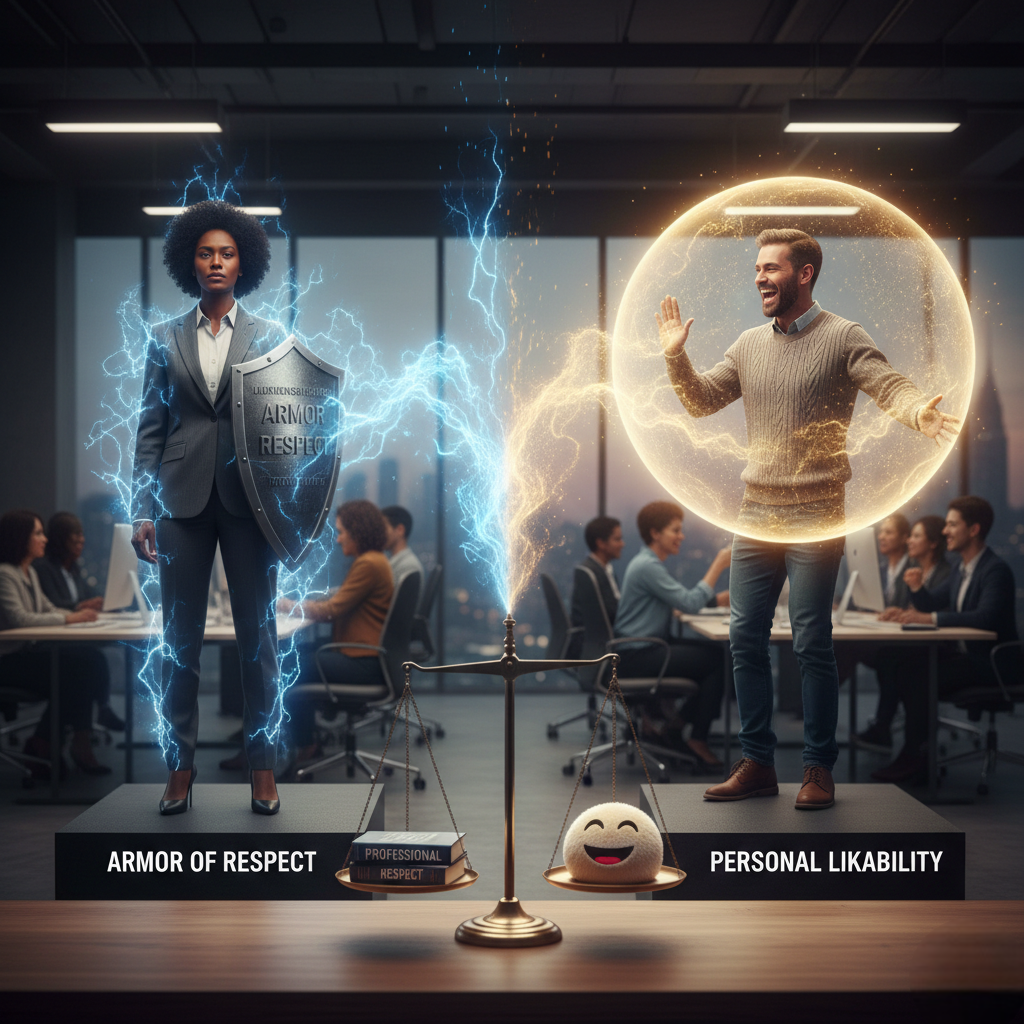
Leadership is where the conflict between professional respect vs personal likeability truly comes to a head. A leader who is only respected but not liked can create a culture of fear and high turnover. Conversely, a leader who is only liked but not respected often oversees a team that is happy but unproductive.
The “Sweet Spot” is a state of warm authority. This is where you are approachable and empathetic (likeable), yet firm on standards and decisive in action (respected).
Case Study: The “Nice” Manager vs. The Respected Manager
Imagine a deadline is missed.
The “Nice” Manager says: “Don’t worry about it, I know you were busy! We’ll catch up next time.” (Result: Likeability increases, but respect for the deadline vanishes.)
The Respected Manager says: “I understand there were hurdles, but we committed to this date. Let’s figure out why it was missed and how to ensure it doesn’t happen again.” (Result: Temporary social friction, but long-term professional respect is established.)
How to Build Respect Without Being "Disliked"
Many fear that choosing respect in the professional respect vs personal likeability debate means becoming a cold, robotic figure. This is a misconception. You can be a deeply kind person while maintaining a high level of professional authority.
1. Be Transparent
Respect is often born from clarity. If people understand the why behind your decisions, they may not like the decision, but they will respect the logic. Transparency bridges the gap between being a “boss” and being a person.
2. Value Integrity Over Popularity
Popularity is fleeting; integrity is permanent. When you make a decision that is right for the company or the project—even if it makes you unpopular in the breakroom—you are investing in your professional respect. Over time, even your detractors will admit that you are fair and principled.
3. Mastering the Art of “Kind Candor”
Kim Scott’s “Radical Candor” framework is a perfect tool for balancing professional respect vs personal likeability. It suggests that you should challenge people directly while showing that you care personally. This ensures you aren’t a “jerk” (respected but not liked) or “ruinously empathetic” (liked but not respected).
The Role of Gender and Culture
It is important to acknowledge that the balance of professional respect vs personal likeability is not always a level playing field. Societal biases often place a “likability penalty” on women and minorities in leadership.
Where a man might be seen as “assertive” (earning respect), a woman exhibiting the same behavior might be labeled “difficult” (losing likeability). Navigating this requires a high degree of emotional intelligence. The goal remains the same—to be respected for one’s output—but the tactics for maintaining likeability may require more nuance depending on the organizational culture.
Why Respect Wins in the Long Run
If you had to choose only one, respect is the engine of career longevity. Likeability can get you through the door, but respect is what keeps you in the room when the big decisions are being made.
When you prioritize professional respect vs personal likeability, you are essentially choosing a “value-based” career over a “validation-based” career.
Validation-based: You feel good when people smile at you.
Value-based: You feel good when the work is excellent and the team is growing.
Ultimately, the most likeable thing you can be in a professional setting is competent and fair. When you are consistently good at your job and treat people with dignity, likeability often follows respect as a natural byproduct.
Balancing the Scales
The debate of professional respect vs personal likeability isn’t about choosing one and discarding the other. It’s about hierarchy. Respect must be the foundation, and likeability should be the architecture built upon it.
By setting clear boundaries, delivering high-quality work, and communicating with “kind candor,” you can navigate the corporate world as someone who is both a pleasure to work with and a force to be reckoned with. Don’t be afraid to trade a little bit of temporary popularity for a lifetime of professional standing.