




In our hyper-connected modern world, we instinctively equate “sophistication” with complexity. We live in an era of sprawling codebases, multi-layered bureaucracies, and global supply chains that require supercomputers to manage. However, if we look back at the most enduring civilizations—from the Roman Empire to the Han Dynasty—we find a radically different philosophy. For these cultures, Elegant Antiquity wasn’t just an aesthetic choice; it was a survival strategy.
Ancient systems succeeded not in spite of their simplicity, but because of it. By stripping away the non-essential, ancient architects, engineers, and governors created structures that could withstand the erosion of time, the volatility of nature, and the unpredictability of human error. Today, as we face the fragility of our own complex systems, the lessons of the past offer a masterclass in resilience.
1. Resilience Through Mechanical Transparency
Modern machines are often “black boxes.” If a single microchip in your car fails, the entire vehicle becomes a multi-ton paperweight because the logic of the system is hidden in microscopic circuitry. In contrast, ancient technology relied on mechanical transparency.
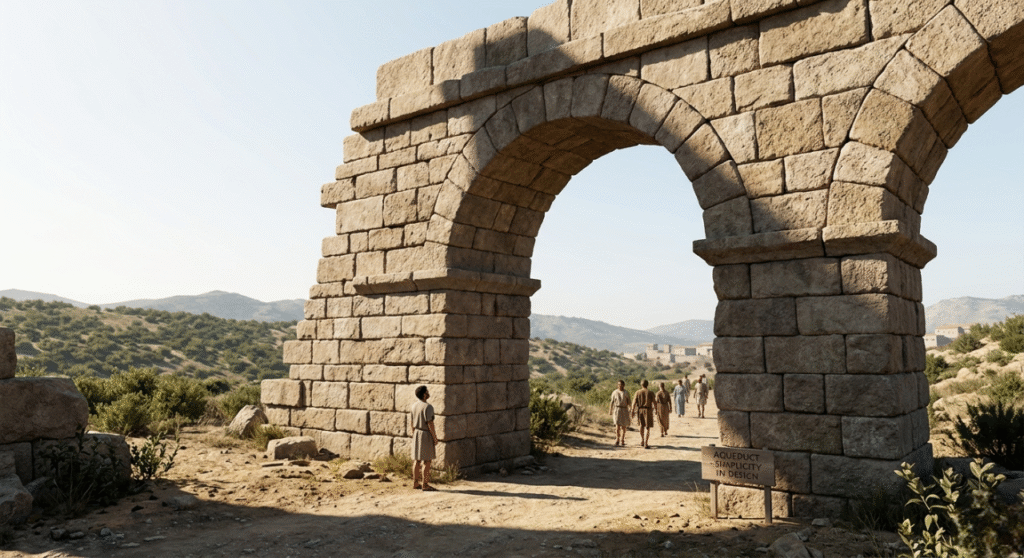
Take the Roman Aqueduct. These massive stone structures moved millions of gallons of water daily using nothing but gravity. There were no electrical pumps to fail, no complex sensors to malfunction, and no specialized software required to manage the flow. The “logic” of the system was built into the physical slope of the stone—usually a precise gradient of about 1 foot for every 3,000 feet of length.
Because the system was simple, it was predictable. If a leak occurred, the source was visible to the naked eye. If a stone cracked, any local mason with a chisel and mortar could fix it. This brand of Elegant Antiquity meant that maintenance didn’t require a specialized degree or a global supply chain for parts; it required only common sense and local materials. This transparency ensured that the water kept flowing for centuries after the engineers who designed them were gone.
2. The Power of Modular Governance and Scalability
The larger an organization grows, the more “noise” enters the communication channel. Modern governments often struggle with “bureaucratic bloat,” where the layers of management become so thick that the top and bottom of the system can no longer hear each other. Ancient empires understood that to manage vast territories without high-speed internet, they had to decentralize.
The Inca Empire managed one of the most rugged terrains on Earth—spanning the Andes Mountains—using a decimal-based administrative system. They broke their population into units of 10, 50, 100, 500, and 1,000 families. Each leader had a clear, simple span of control and a direct line of accountability. This modularity allowed the empire to scale rapidly without creating a convoluted central bureaucracy.
By keeping the rules of governance simple, the Inca ensured that their policies were understood from the high mountain peaks to the coastal deserts. This is a hallmark of Elegant Antiquity: creating systems where the “interface” between the government and the citizen is direct, uncomplicated, and therefore harder to corrupt or misunderstand.
3. Sustainable Architecture and the Lindy Effect
In the world of probability, the “Lindy Effect” suggests that the future life expectancy of a non-perishable thing (like an idea or a building) is proportional to its current age. The Parthenon has stood for 2,500 years; your local office park will likely be demolished or collapse in 40.
Why does ancient architecture last? It comes down to the simplicity of materials and forces. Ancient builders relied on fundamental physics:
Compression: Using the weight of stones to hold them together (arches and domes) rather than relying on tension or chemical glues.
Local Sourcing: Using stone, clay, and timber found within the immediate environment, ensuring the building was “native” to its climate.
Thermal Mass: Thick walls that naturally regulated temperature, absorbing heat during the day and releasing it at night, eliminating the need for fragile HVAC systems.
When we study Elegant Antiquity in architecture, we see that by avoiding complex chemical binders or fragile steel skeletons prone to rust, these structures became nearly immortal. They worked with the laws of gravity rather than trying to outsmart them with high-maintenance technology.
4. Financial Systems Without the Friction
Modern finance is a web of derivatives, high-frequency trading, and digital ledgers. While efficient in a vacuum, it is also incredibly fragile—one “glitch” or a sudden loss of confidence can trigger a global recession.
Ancient economies often relied on commodity money or simple credit tallies. While we might view a gold coin or a silver talent as primitive, they represented an “offline” store of value that required no third-party verification to exist. The Elegant Antiquity of a gold-standard or a simple grain-based ledger meant that trade could continue even if a central government collapsed. The system was “decoupled” from the state’s immediate health, providing a level of economic autonomy and stability that is hard to find in the digital age. In ancient Babylon, debt was often recorded on clay tablets; if the system became too burdened, a “Clean Slate” decree could be issued, simply breaking the tablets and resetting the economy—a solution far simpler than modern “quantitative easing.”
5. Information Density: The Quipu and the Alphabet
How do you store data for a thousand years? We currently use hard drives that degrade in a decade and file formats that become obsolete in twenty years. The ancients solved the “data rot” problem through physical simplicity.
The Phoenician alphabet was a revolutionary simplification. By moving from thousands of complex hieroglyphs to roughly 22 simple phonetic signs, literacy became accessible to the masses. It was an information system designed for maximum transmission with minimum error.
Similarly, the Inca used the Quipu, a system of knotted strings. It was lightweight, portable, and didn’t require power. It was a tactile, binary-adjacent method of record-keeping that thrived on the principle of Elegant Antiquity. It was data storage reduced to its most indestructible form—one that could be carried across mountains by runners and remain readable for centuries.
6. Minimalist Law: From Hammurabi to the Modern Era
Modern law books are millions of pages long, requiring teams of lawyers to interpret a single clause. Contrast this with the Code of Hammurabi. While harsh by modern standards, its strength lay in its absolute clarity. “If a builder builds a house for someone, and does not construct it properly… that builder shall be put to death.”
While we don’t advocate for the severity of the punishment, the simplicity of the incentive structure is undeniable. It created a system of “skin in the game.” There was no “corporate veil” to hide behind. When laws are simple and consequences are direct, people act with a level of care that complex regulations often fail to produce. When we embrace Elegant Antiquity in our rules, we reduce the “transaction costs” of society—the time and money spent just trying to figure out what the rules are.
7. The Logic of Ancient Logistics
We often think of the Silk Road as a singular “highway,” but it was actually a decentralized network of independent caravansaries. There was no “CEO of the Silk Road.” Instead, it was a system of simple, repeatable protocols. A merchant would travel from one hub to the next, trade their goods, and return.
How can we use the lessons of Elegant Antiquity today? By looking at how these ancient networks survived for over 1,500 years without central management. They relied on “stigmergy”—a mechanism of indirect coordination where the environment (the trade route) provided the cues for action. This is the opposite of modern “just-in-time” logistics, which are highly optimized but collapse the moment a single ship gets stuck in a canal. Ancient logistics were “redundant,” meaning if one path was blocked by war or weather, the system simply flowed through another, like water around a stone.
8. Why "Simple" is Harder Than "Complex"
Steve Jobs famously said, “Simple can be harder than complex: You have to work hard to get your thinking clean to make it simple.” The ancients didn’t have the luxury of “masking” poor design with excess energy or advanced technology. If a bridge was poorly designed, it fell. If a law was too complex, it was ignored.
This forced a Darwinian pressure on their systems: only the simplest, most effective methods survived. The Elegant Antiquity of the past serves as a blueprint for a more sustainable future because it forces us to focus on “First Principles.” We are learning that redundancy is often better than optimization, and that transparency is more valuable than speed.
9. The Psychological Strength of Simplicity
Complexity breeds anxiety. When we don’t understand how our world works—how our food is grown, how our money is created, or how our laws are written—we feel a loss of agency. We become “users” of a system rather than “citizens” of a society.
Ancient systems provided a sense of “understandable reality.” A citizen in a Greek polis understood the mechanics of their democracy because it happened in a physical square, not on an algorithmic feed. This psychological grounding is perhaps the greatest strength of Elegant Antiquity. It creates a world that is “human-scale.” It allows individuals to see the direct relationship between their actions and the results, fostering a sense of responsibility and mental well-being that is often lost in the “noise” of modernity.
10. Applying Simplicity to Modern Challenges
As we look toward a future defined by AI and automation, the principles of Elegant Antiquity become more relevant, not less. We need systems that are “anti-fragile”—systems that don’t just survive shocks but thrive because of them.
In software engineering, this means prioritizing “vanilla” code and local data over heavy frameworks and cloud dependencies. In business, it means reducing the number of meetings and layers of management to restore direct communication. In our personal lives, it means moving toward “low-tech” solutions for everyday problems—methods that worked for our ancestors and will likely work for our grandchildren.
The Endurance of the Simple
The pyramids, the Great Wall of China, and the Roman roads weren’t built with magic; they were built with a deep, uncompromising commitment to the power of the simple. They remind us that the most sophisticated thing you can do is find a solution so simple that it looks inevitable.
By studying Elegant Antiquity, we learn that to build something that lasts forever, you must first learn what to leave out. Simplicity is not the absence of complexity; it is the mastery of it. It is the ability to distill the chaos of the world into a form that is durable, understandable, and beautiful.
The legacy of Elegant Antiquity proves that while complexity might win the moment, simplicity wins the millennium. As we move forward into an increasingly uncertain century, we should strive for that same clarity in everything we build. We don’t need more “features”; we need more “foundations.” We don’t need more “layers”; we need more “logic.” By looking back, we find the path forward—a path paved with the elegant simplicity of the ancients.