



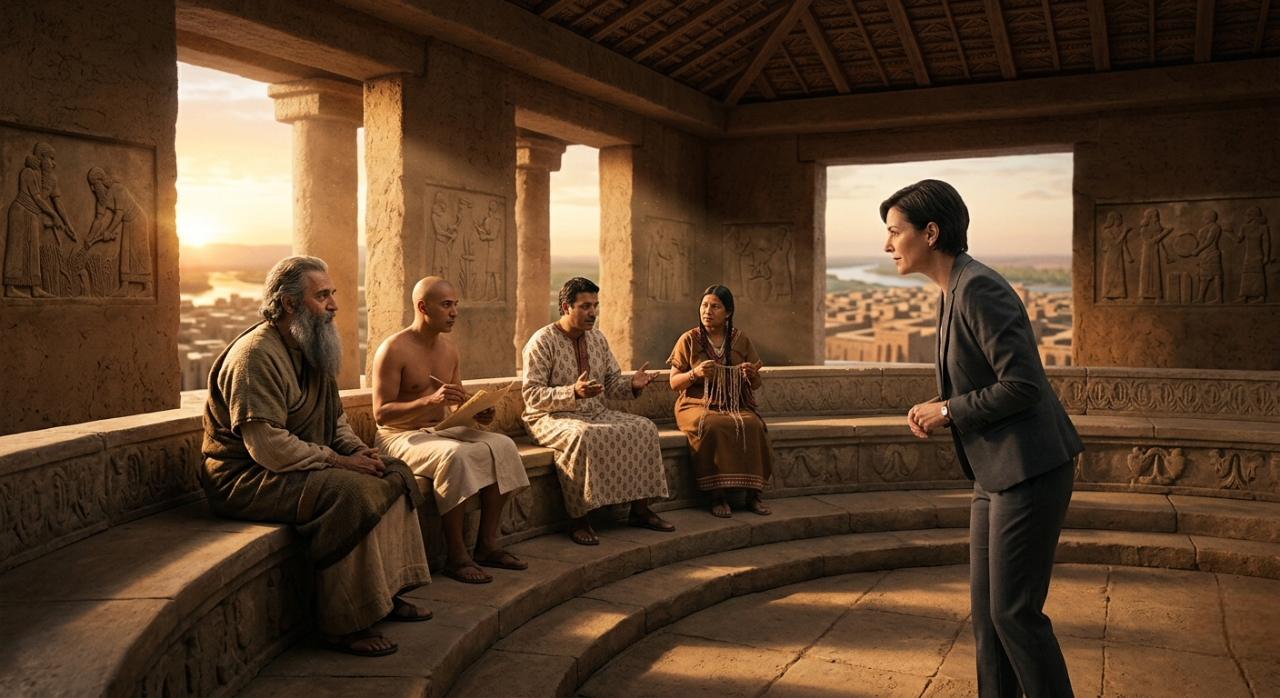
In the hyper-competitive corporate world of 2026, we often look toward the latest management software or AI-driven organizational charts to solve the problem of workplace friction. Yet, despite our advanced tools, modern organizations are plagued by burnout, toxic power struggles, and bureaucratic gridlock. This has led historians and leadership experts to ask a startling question: How did civilizations like the Indus Valley, the Incas, and the early Romans manage vast, complex hierarchies for centuries without falling into perpetual internal warfare? The answer lies in a concept we have largely forgotten: the ancestral order blueprint.
Ancient societies didn’t just have bosses and subordinates; they had sophisticated systems of mutual obligation, sacred duty, and rhythmic restructuring that prevented the accumulation of toxic power. By studying the ancestral order blueprint, we can find the missing keys to modern leadership and organizational stability.
1. The Myth of the "Great Man" vs. the System
We often mistakenly believe that ancient hierarchies were simply about a single brutal dictator at the top. However, archaeological evidence from the Indus Valley suggests a different reality. These cities were masterpiece examples of the ancestral order blueprint, featuring standardized urban planning and complex trade networks without evidence of grand palaces for “god-kings.”
Their hierarchy was functional rather than ego-driven. Status was tied to contribution to the collective infrastructure—water management, granary security, and trade logistics. When the ancestral order blueprint is built on functional expertise rather than inherited or seized power, chaos is minimized because every level of the hierarchy understands its specific value to the survival of the group.
2. Reciprocity: The "Sacred Contract" of Leadership
In many ancient Andean societies, leadership was governed by the principle of Ayni (reciprocity). A leader’s status was not measured by what they took, but by what they provided. Under this ancestral order blueprint, a high-ranking official was expected to host festivals, provide for the vulnerable during droughts, and lead from the front in labor projects.
This created a “check and balance” system. If a leader stopped providing value or became a tyrant, they violated the ancestral order blueprint, losing their divine and social mandate. In modern terms, this is the difference between a “boss” who demands results and a “leader” who provides the resources and psychological safety for their team to thrive.
3. Ritualized Conflict and Venting Mechanisms
Ancient societies knew that hierarchy naturally creates tension. Instead of letting that tension build into a revolution, they used the ancestral order blueprint to create “safety valves.” Many cultures had specific times of year—like the Roman Saturnalia—where social roles were temporarily reversed or suspended.
By allowing subordinates to voice grievances or even “rule” for a day in a ritualized setting, the ancestral order blueprint acknowledged the humanity of those at the bottom. This prevented the “slow burn” of resentment that leads to modern-day “quiet quitting” or office politics. It recognized that for a hierarchy to be stable, it must occasionally breathe.
4. The Stability of Tribal Circles
Before the rise of massive empires, the primary ancestral order blueprint was the tribal council. In these settings, hierarchy was “flat-but-deep.” Elders held authority not because of force, but because of accumulated wisdom and institutional memory.
Decisions were rarely made by a single person in a vacuum. The ancestral order blueprint required consensus-seeking among representatives of different clans. This ensured that even if there was a “chief,” their power was moderated by a council of peers. This is a direct ancestor to the modern “Board of Directors,” though the ancients prioritized long-term communal health over short-term “shareholder” gains.
5. Meritocracy in the Shadows of Tradition
While we view ancient societies as rigid, many utilized an ancestral order blueprint that allowed for high social mobility. The Mongol Empire, under Genghis Khan, famously ignored noble birth in favor of battlefield performance and loyalty.
By baking meritocracy into the ancestral order blueprint, these societies ensured that the most capable individuals were in positions of power. Chaos usually erupts when incompetent people hold high rank simply through nepotism. The ancients understood that a hierarchy that fails to promote talent is a hierarchy destined for collapse.
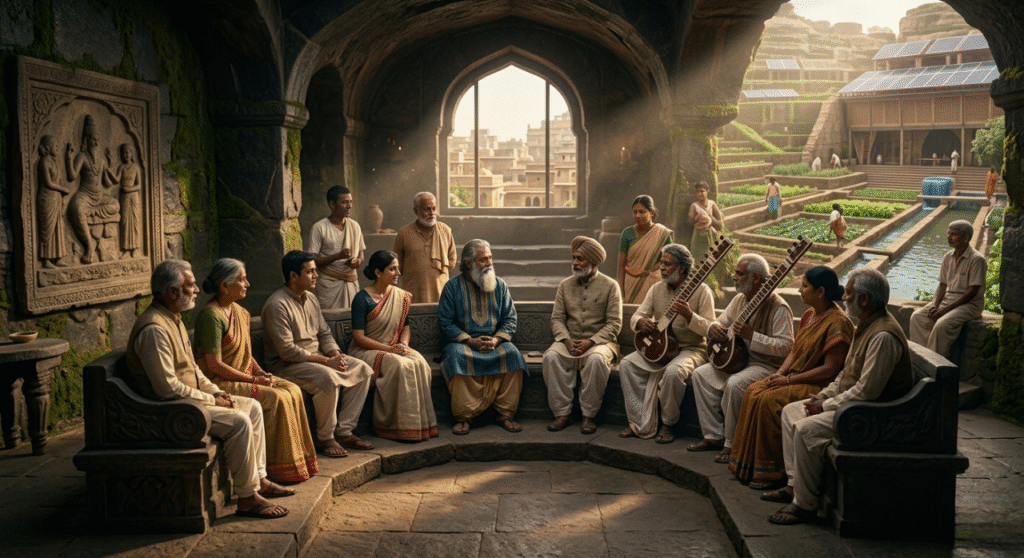
6. Architecture as an Anchor of Order
Hierarchy was often physically represented in the landscape. Whether it was the Ziggurats of Mesopotamia or the Pyramids of Giza, the ancestral order blueprint was visible to everyone. This wasn’t just about intimidation; it was about orientation.
When everyone knows exactly where they fit within the grander scheme of a project—be it building a temple or a city—chaos is reduced. The ancestral order blueprint provided a sense of “cosmic place.” In the modern workplace, a lack of clear role definition is one of the leading causes of stress. The ancients used stones; we use job descriptions, but the underlying need for structural clarity remains the same.
Comparison: Ancient vs. Modern Hierarchy
| Feature | Ancient (Ancestral Order Blueprint) | Modern (Bureaucratic Model) |
| Foundation | Mutual Obligation & Duty | Contractual & Financial |
| Conflict Handling | Ritualized Release / Festivals | Performance Reviews / HR |
| Status Source | Contribution to Collective | Title & Seniority |
| Decision Style | Council Consensus | Top-Down Command |
7. The Role of Shared Narrative and Myth
Perhaps the most effective tool in the ancestral order blueprint was the shared story. Whether it was a religious text or a foundation myth, everyone from the king to the farmer believed they were part of a single, divine mission.
When a group shares a deep, emotional narrative, they are willing to accept hierarchy because they believe it serves a higher purpose. When the ancestral order blueprint loses its “Why,” it becomes a cold, oppressive machine. Modern companies often struggle with this, trying to replace “purpose” with “mission statements” that no one actually believes in.
8. Managing the "Outliers" and the Ambitious
Every society has individuals with high ambition who can disrupt the peace. The ancestral order blueprint managed these people by giving them clear avenues for advancement—usually through military conquest, priesthood, or trade exploration.
By directing ambitious energy outward or toward specialized mastery, the ancestral order blueprint protected the internal core of the society from power struggles. In contrast, modern corporate structures often force ambitious people to fight one another for a single “VP” slot, creating the very chaos the ancients worked so hard to avoid.
9. The Wisdom of the "Slow" Hierarchy
Ancient hierarchies didn’t change every fiscal quarter. They moved at the speed of generations. This ancestral order blueprint prioritized stability over “disruption.” While this might seem “un-innovative” to a 2026 tech founder, it allowed civilizations to last for 1,000 years.
There is a lesson here: speed often breeds chaos. By slowing down the pace of structural change, the ancestral order blueprint allowed social bonds to strengthen. It prioritized the “organic” growth of leadership over the “synthetic” restructuring we see today.
Reclaiming the Blueprint
The reality behind how ancient societies managed hierarchy is that they didn’t treat people as “resources”—they treated them as integral parts of a living organism. By following the ancestral order blueprint, they balanced power with responsibility, ambition with ritual, and status with service.
As we look toward the future of leadership in an AI-integrated world, the most “innovative” thing we can do is look backward. We don’t need more dashboards; we need a return to the principles of the ancestral order blueprint: clarity, reciprocity, and shared purpose.
The chaos of the modern workplace isn’t a failure of technology; it’s a failure of structure. It’s time to rebuild our organizations on a foundation that has already stood the test of millennia.