



In the hyper-competitive global marketplace of 2026, the most valuable commodity isn’t data or speed—it is clarity. It is the ability to synthesize complex information, identify subtle market shifts, and innovate before a competitor does. This rare skill is called “deep thinking,” the mental state of sustained focus required for breakthroughs. Yet, despite being surrounded by high-tech performance tools, many leaders and knowledge workers feel their ability to enter this state is rapidly eroding. This frustration is not an isolated problem; it is the connectivity-cognition tax, a structural consequence of living in a world of constant, seamless communication.
To solve this mental gridlock, we must look beyond the generic “digital detox” advice and examine the structural and psychological reasons why our minds are losing their edge.
1. The Myth of the "Seamless" Workflow
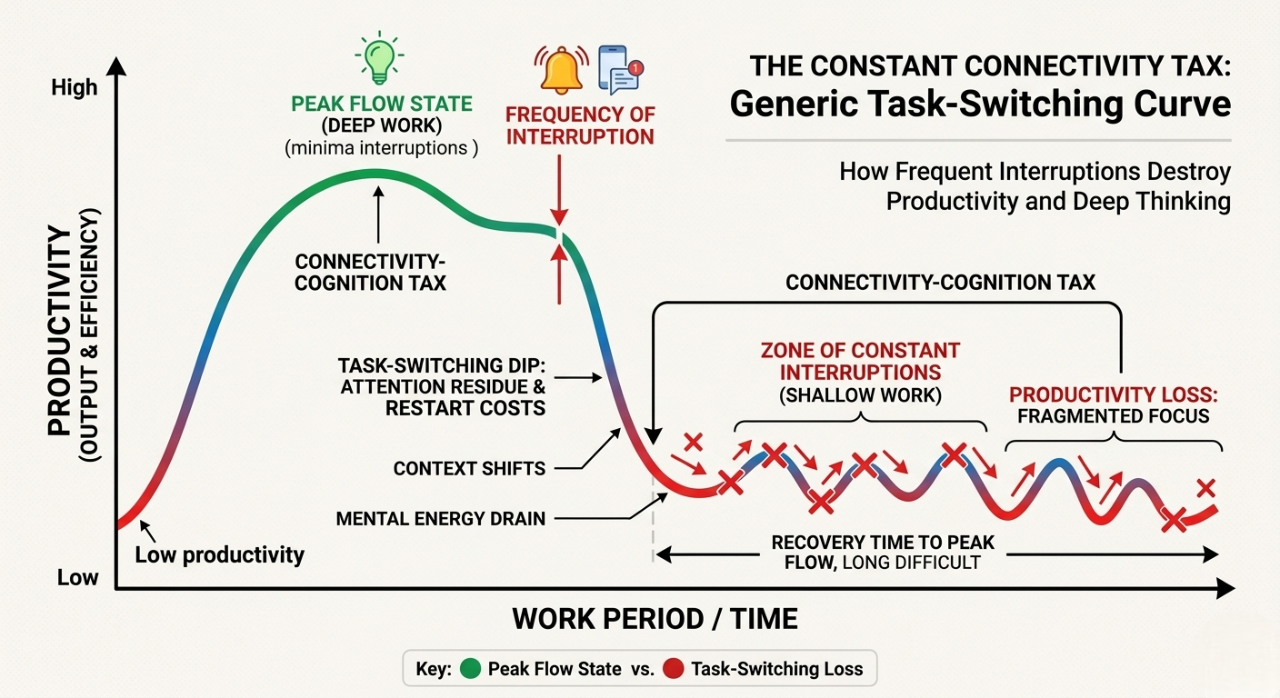
Our modern office environments are built on the promise of “seamless collaboration.” But what we often experience is “seamless interruption.” The connectivity-cognition tax is paid every time a workflow is fragmented. In 2026, the average knowledge worker switches tasks every few minutes. Every new notification—whether from an AI-assistant, a team chat, or a generic operational update—creates a context shift.
Context-switching doesn’t just lose time; it loses mental resources. The brain needs 10 to 20 minutes of uninterrupted focus to achieve the “flow state” required for deep thinking. Constant connectivity denies us that ramp-up period, leaving us perpetually struggling with “attention residue,” where parts of our mind are still processing the previous message, making it impossible to apply full cognitive load to the task at hand.
2. Dopamine, the Enemy of Slow Innovation
Our brains are wired to seek novelty, a survival mechanism that has been hijacked by our technology. We are paying the connectivity-cognition tax by training our neurochemistry. Deep thinking, like mastering leadership psychology or complex stakeholder management, is slow and often frustrating. In contrast, checking a notification or scrolling through a news feed provides an instant micro-hit of dopamine.
We stay constantly connected because we have conditioned our minds to prefer the shallow, immediate reward of connectivity over the slow, rich reward of deep thought. The brain literally gets “out of shape.” A professional who can’t sit for 30 minutes without a digital hit is not just “distracted”; they are paying a biochemical connectivity-cognition tax that has eroded their vocational capacity.
3. The Death of Solitude
One crucial reason for the connectivity-cognition tax is the erosion of true solitude. Great strategic thinking often happens during moments of idleness—the walk to the coffee shop, the quiet commute. These moments of mental “empty space” allow the subconscious to process “thick data,” connecting disparate pieces of information.
Constant connectivity eliminates these “Safety Valves.” When we pick up our device the moment we have a second of downtime, we deny our mind the space it needs to synthesize. Direction, purpose, and innovative strategy are products of reflection. If your mind is 100% full with external data, you are literally too busy to generate new insight. This lack of deep strategic synthesis is the hidden cost of the connectivity-cognition tax.
4. The Burden of Availability and "Status-Seeking"
Success and financial reward can ironically increase the connectivity-cognition tax. The higher your title, the higher the expectation for immediate availability. You stay constantly connected not because you enjoy it, but because the corporate culture and your lifestyle expectations demand it.
This constant connectivity leads to “Decision Fatigue.” Direction requires the “courage to prune”—the ability to say “no” to five immediate demands so you can say “yes” to the one strategic opportunity that matters. By trading our strategic focus for tactical reactivity, we pay a massive connectivity-cognition tax.
5. Information Overwhelm and the Paradox of Choice
By 2026, we have access to too much data. We could research, track competitive intelligence, or study five different leadership philosophies simultaneously. This abundance of choice leads directly to the connectivity-cognition tax through sheer mental exhaustion.
When we stay connected to every information stream, we often choose none. We stay in our current lane not because we like it, but because the effort of synthesizing the next choice is too high. Direction requires focus. The ancients knew this: they prioritized consensus-seeking among representatives, recognizing that for any hierarchy or strategy to be stable, it required occasional breathing room, which constant connectivity eliminates.
6. The Need for "Cognitive Rites of Passage"
In the modern corporate world, we have no clear markers for moving from “Warrior” (the high-output executor) to “Elder” (the mentor or strategist). Many feel the connectivity-cognition tax because they are mentally ready to be an “Elder,” but the system, fueled by constant data-blindness traps, keeps asking them to act like a “Warrior,” demanding more speed, more metrics, and more connectivity.
Without a clear transition into roles centered on guidance, deep thinking, and building long-term communal health, senior professionals feel like they are just repeating the same high-output year over and over.
Comparison: Reactivity vs. Direction
| Feature | The Reactively Connected | The Directed Thinker |
| Focus | Efficiency and Output | Impact and Legacy |
| Motivation | Avoiding Failure / Status | Pursuing Vision / Purpose |
| Growth Type | Task-based (Linear) | Domain-based (Exponential) |
| Feeling | Busy but Empty | Challenged but Fulfilled |
7. Reclaiming deep work in a busy world
The most critical asset in your toolkit is your time. If your calendar is 100% full, you are paying the ultimate connectivity-cognition tax.
Audit Your Impact, Not Your Connected Hours: What is the one thing you did this month that actually made a strategic difference? Double down on that.
Define “Portable Identity”: Your self-worth should not be tied to being “The Director of X” but on your generic “Wisdom.” True direction requires a self-identity that is “portable”—one that works whether you are in a boardroom or starting a solo consultancy. Breaking the identity-career fusion is a powerful antidote to the connectivity-cognition tax.
8. Embracing the "Expertise Blind Spot"
The more of an expert you become, the more you stop asking “stupid” questions, which is a key driver of the connectivity-cognition tax. Curiosity is a cognitive safety valve. To find direction again, you must embrace the “Beginner’s Mind.” Direction is often found at the intersection of what you already know and something you are totally new at.
9. Breaking the connectivity-cognition tax
How do you reclaim your sense of direction and your deep thinking capability? It isn’t about running away from technology.
Build a “Personal Board of Directors”: Surround yourself with a few people who don’t care about your title but care about your growth. They are your external context-check.
The “Grandmother Test” for Connectivity: If your grandmother or a non-professional cannot understand what you are doing, you might be over-complicating it, often a side effect of paying the connectivity-cognition tax on too much raw data.
10. The Power of the "Mid-Career Pivot"
A pivot doesn’t have to be a 180-degree turn. Many who overcome the connectivity-cognition tax do so by moving into coaching, counseling, or social-impact roles where their 15 years of “corporate battle scars” become a valuable asset. Use your experience not as a weight (golden handcuffs), but as the fuel for the next domain.
From Reactive to Proactive
The reality behind why constant connectivity is reducing deep thinking ability is that we have mistaken “activity” for “progress” and “connectivity” for “wisdom.” We are running on a treadmill, and the connectivity-cognition tax is the constant exhaustion we feel.
Finding direction in 2026 isn’t about finding a new job or a new app; it’s about finding a new version of yourself—one that values wisdom over widgets and legacy over likes. Use your mental experience not as a high-end cage, but as the foundation for the most meaningful chapter of your life yet.