



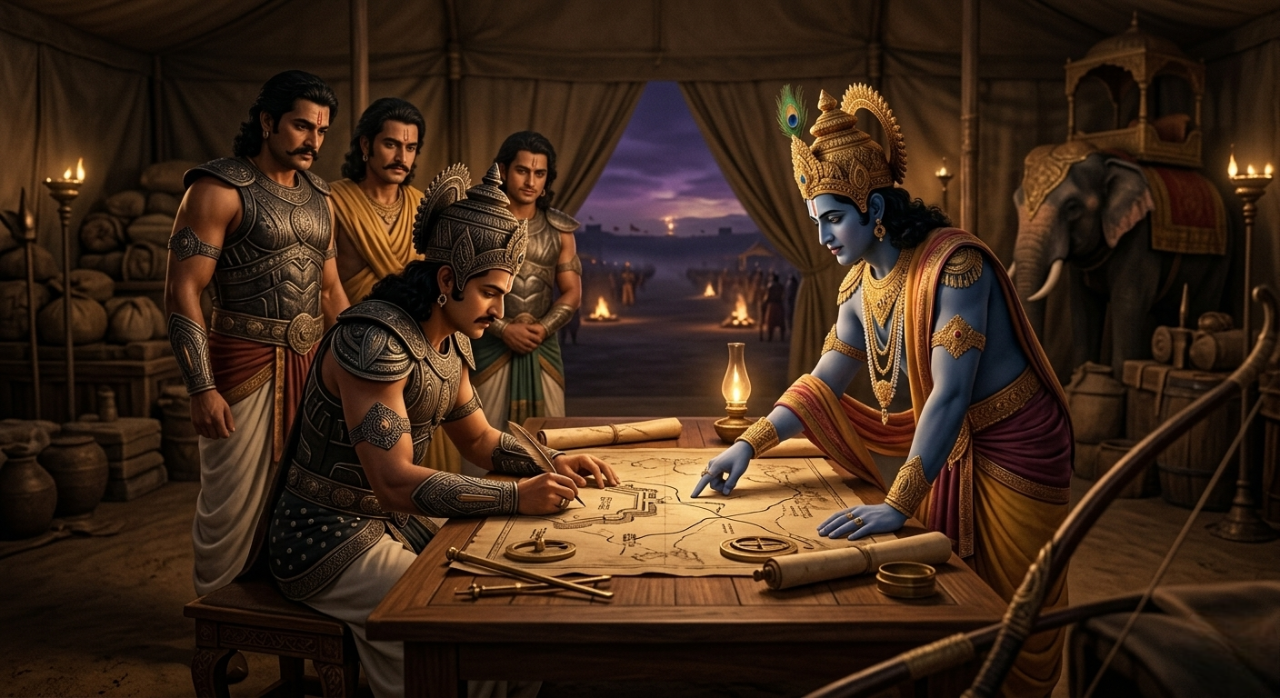
The Mahabharata is not merely an ancient epic; it is an exhaustive treatise on the human condition, governance, and the intricate dance between ambition and morality. Often described as the “Greatest Story Ever Told,” its verses contain timeless wisdom that resonates as strongly in modern boardrooms and political corridors as it did on the battlefield of Kurukshetra.
In a world increasingly grappling with corporate scandals, leadership crises, and ethical dilemmas, turning to the Mahabharata leadership lessons provides a robust framework for navigating the complexities of power and responsibility.
1. The Burden of Power: Dhritarashtra’s Blindness
Power is a double-edged sword. In the epic, King Dhritarashtra represents the dangers of “attachment-led leadership.” His physical blindness was mirrored by a metaphorical blindness toward his sons’ transgressions. Because he prioritized his love for Duryodhana over his duty as a king, he allowed the seeds of war to be sown.
Modern Application: For today’s executives, the lesson is clear: Personal bias is the enemy of professional excellence. When leaders favor “yes-men” or family members over merit, the organizational culture rots from within. Mahabharata leadership lessons teach us that true power requires the detachment to see reality as it is, not as we wish it to be.
2. Ethics vs. Expediency: The Dilemma of Yudhishthira
Yudhishthira, the eldest Pandava, is the embodiment of Dharma (Righteousness). However, his journey reveals that ethics are rarely black and white. From his fatal flaw in the game of dice to his “half-truth” about Ashwatthama’s death, Yudhishthira shows that even the most ethical leaders must sometimes navigate the “gray zones” of responsibility.
Corporate Parallel:Modern businesses often face situations where the “right” path isn’t profitable and the “profitable” path isn’t right. Mahabharata leadership lessons emphasize that while absolute perfection may be impossible, one must never lose sight of the long-term moral objective. Responsibility means being accountable for the “half-truths” we tell in our marketing and financial reporting.
3. The Power of Coaching: Krishna as the Supreme Strategist
Lord Krishna did not pick up a weapon during the war, yet he was the architect of victory. He served as a mentor, a coach, and a strategist to Arjuna. When Arjuna faced a paralyzing mental breakdown on the battlefield, Krishna didn’t just give him a solution; he gave him a perspective—the Bhagavad Gita.
Management Insight: The best leaders are not those who do all the work, but those who empower their teams to realize their potential. Mahabharata leadership lessons highlight the importance of servant leadership. A modern manager should strive to be like Krishna: providing the right data and mental framework for their “Arjunas” to make the final shot.
4. Responsibility and Individual Accountability: The Fall of Karna
Karna is perhaps the most tragic figure in the epic. Despite being exceptionally talented, his loyalty to the “wrong side” led to his downfall. He chose his friendship with Duryodhana over his duty to the truth.
5. Strategic Alliances and Resource Management
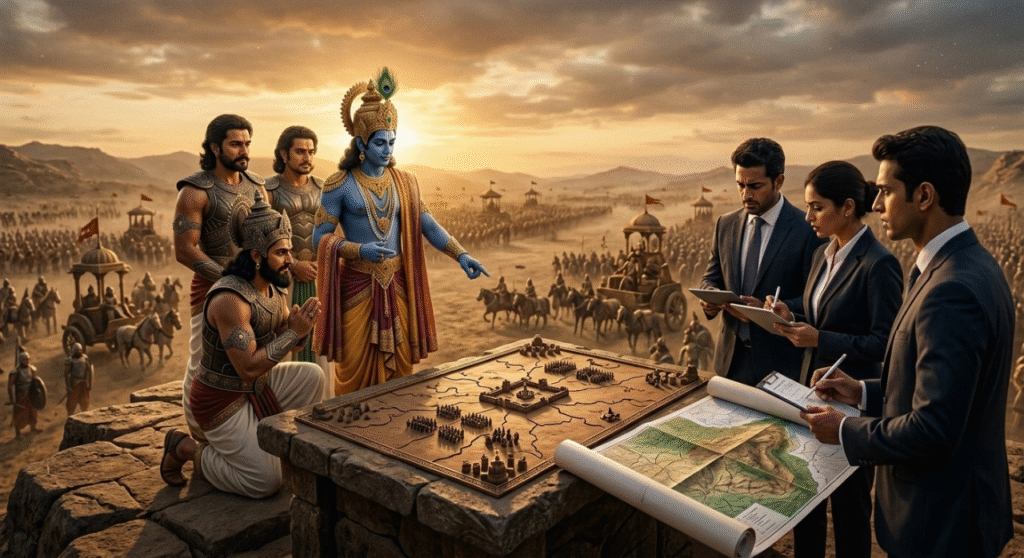
The Pandavas had fewer soldiers and smaller resources than the Kauravas. However, they won because of their superior alliance management and strategic delegation. They sought help from diverse groups, whereas the Kauravas relied on a top-heavy structure where the generals (Bhishma, Drona, Karna) were often at loggerheads.
Business Strategy: In a competitive market, it is not always the biggest company that wins, but the one with the best ecosystem. Mahabharata leadership lessons suggest that a leader’s responsibility is to ensure team synergy. Internal politics—much like the friction between the Kaurava generals—can destroy a giant organization from the inside.
6. Diversity and Inclusion: Draupadi’s Voice
The epic reaches its darkest point when the elders of the court remain silent during Draupadi’s humiliation. This silence represents a failure of institutional responsibility. A system that cannot protect the dignity of its stakeholders is a system destined for collapse.
Modern Governance: Psychological safety and inclusion are not just “HR initiatives”; they are the bedrock of ethical leadership. When leaders stay silent in the face of workplace harassment or systemic bias, they are effectively choosing the path of the Kauravas. Ethical responsibility requires standing up when the “status quo” is wrong.
7. Sustainability and the "End Game"
The Kurukshetra war was a victory for the Pandavas, but it came at a staggering cost. Almost everyone died. This prompts a vital question: Is a victory worth it if nothing is left to govern?
Sustainable Leadership: Modern organizations often chase quarterly results at the cost of employee burnout and environmental degradation. Mahabharata leadership lessons urge us to look at the “aftermath.” Responsibility means ensuring that your path to success doesn’t leave a trail of destruction that makes your “win” meaningless.
Comparison of Character Archetypes in Leadership
| Character | Leadership Trait | Risk Factor |
| Bhishma | Unwavering Loyalty | Rigid adherence to outdated rules |
| Arjuna | Exceptional Skill | Paralyzing self-doubt |
| Duryodhana | High Ambition | Greed and lack of empathy |
| Vidura | Moral Compass | Often ignored by the powerful |
| Krishna | Strategic Vision | Misunderstood by the conventional |
8. Managing Ego: The Downfall of Shalya
Shalya, the King of Madra, was tricked into fighting for the Kauravas and spent his time demotivating Karna instead of supporting him. This internal sabotage is a classic example of how ego ruins responsibility.
Corporate Lesson: “Ego clashes” are the most common reason for project failures. Mahabharata leadership lessons teach us that when we are part of a team, our primary responsibility is the collective goal, not our personal status.
9. Agility and Innovation: Abhimanyu’s Courage
Young Abhimanyu knew how to enter the Chakravyuha (a complex military formation) but not how to exit. While his death was a tragedy, his willingness to take on an impossible challenge speaks to the spirit of innovation.
Startup Culture: In the business world, you will often find yourself in a “Chakravyuha”—a complex market situation with no clear exit strategy. The lesson here is about preparedness. Innovation must be backed by a full understanding of the lifecycle of a project, from entry to exit.
10. The Power of Choice
Ultimately, the Mahabharata is a story of choices. Arjun chose Krishna’s guidance over his army. Duryodhana chose the army. One chose wisdom; the other chose brute force. Power is a gift, ethics is a choice, and responsibility is a burden we must carry with grace. By integrating Mahabharata leadership lessons into our daily professional lives, we can move away from transactional management toward a more “Dharmic” leadership style—one that builds wealth without losing its soul.