




We have all been there: lying awake at 3:00 AM, replaying a conversation from three years ago or mentally rehearsing a presentation until the words lose all meaning. It feels like a glitch in the system—a relentless loop that serves no purpose other than to drain our energy. But to truly understand how to stop it, we must first understand why overthinking happens from a biological and neurological standpoint.
The human brain is an extraordinary machine, but it is important to remember that it was designed for survival in a primitive world, not necessarily for emotional equilibrium in a modern one. Overthinking, or “rumination,” is often a byproduct of a system that is trying too hard to keep you safe. In this deep dive, we will peel back the layers of the prefrontal cortex, the amygdala, and the intricate chemical pathways of the mind to see what is actually occurring when your thoughts refuse to go quiet.
1. The Executive Suite: The Prefrontal Cortex
To understand why overthinking happens, we must first look at the brain’s “Executive Suite”—the Prefrontal Cortex (PFC). This area, located just behind your forehead, is the most evolved part of the human brain. It is responsible for complex planning, decision-making, social behavior, and the moderation of our impulses. In a healthy state, the PFC acts like a CEO, directing thoughts toward productive outcomes and solving problems effectively.
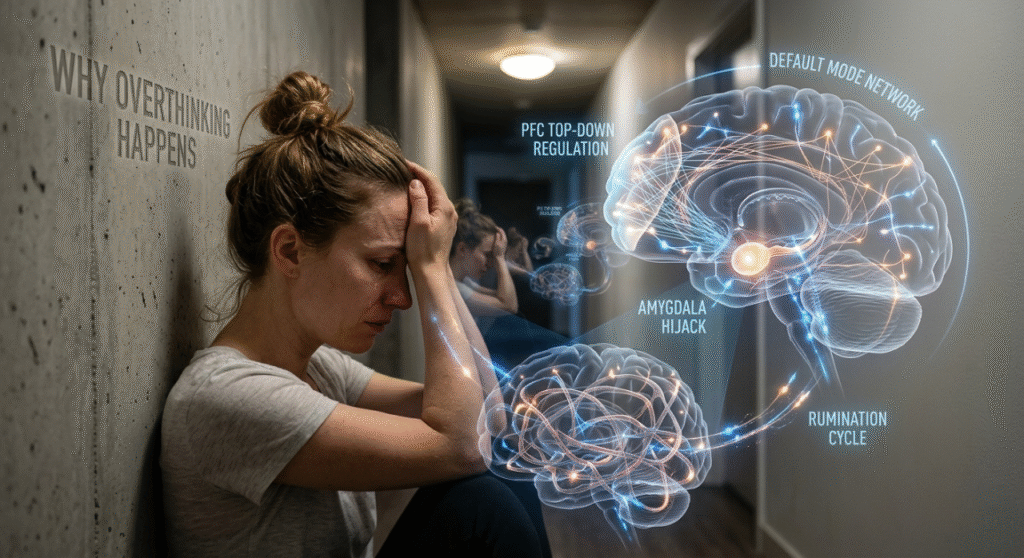
However, when we fall into a cycle of overthinking, the PFC becomes hyper-active. It enters a state of “top-down” over-regulation. Instead of simply solving a problem, the brain begins to simulate every possible negative outcome in an attempt to “protect” itself from future threats. The CEO is no longer making decisions; instead, the CEO is trapped in a boardroom with a thousand different scenarios, unable to choose one. This creates a “bottleneck” in our cognitive processing, leading to the mental paralysis we recognize as overthinking.
2. The Amygdala Hijack and the Fear Circuit
At the core of why overthinking happens is the amygdala, a small, almond-shaped cluster deep within the temporal lobe. The amygdala is the brain’s alarm system. Its primary job is to detect threats in the environment and trigger the “fight or flight” response. In the ancient world, this was a life-saving mechanism—it detected the rustle in the grass that might be a predator.
In the modern world, physical threats are rare, but psychological threats are constant. An unread email, a cryptic text from a partner, or a performance review can trigger the same biological response as a tiger. When the amygdala stays “on,” it sends continuous distress signals to the rest of the brain. The PFC tries to make sense of this physical anxiety by searching for a logical reason. This leads to the “What If” loop. Your brain isn’t just thinking; it is trying to solve a feeling of fear that hasn’t actually manifested into a real-world problem yet. This mismatch between our ancient hardware and modern software is a fundamental reason why overthinking happens.
3. The Default Mode Network (DMN): The Brain's "Idle" State
Neuroscience has identified a specific network in the brain called the Default Mode Network (DMN). This network becomes active when you aren’t focused on a specific task—when you’re daydreaming, reflecting on the past, or thinking about the future. It is essentially the brain’s “rest” state, allowing for creativity and self-reflection.
While the DMN is essential for a sense of self, it is also the primary site of rumination. In people prone to chronic anxiety, the DMN is often “sticky.” It has trouble switching off. This is a primary reason why overthinking happens: the brain gets stuck in an internal-facing mode and fails to pivot back to the “Task-Positive Network” (TPN), which is active when we are engaged in the outside world. When the DMN and TPN are out of balance, the mind becomes a hall of mirrors, reflecting the same worries over and over again without the input of external reality to break the cycle.
4. Chemical Chaos: The Balance of Glutamate and GABA
On a microscopic level, the question of why overthinking happens comes down to the balance between excitation and inhibition in the brain’s neurochemistry.
Glutamate is the brain’s primary excitatory neurotransmitter. It gets neurons firing and helps us stay alert, learn new things, and process information.
GABA (gamma-aminobutyric acid) is the inhibitory neurotransmitter. It acts as the “brakes,” telling the brain it’s time to slow down and relax.
When we overthink, there is often a Glutamate-GABA imbalance. The brain is flooded with excitatory signals, making it nearly impossible to “turn off” a thought. This is why you feel “wired but tired”—your body is exhausted, but your neurons are still firing at a rapid-response rate. Chronic stress depletes our GABA reserves, leaving the “accelerator” of the brain stuck in the down position. This chemical storm is a major physiological driver behind why overthinking happens.
5. Evolutionary Origins: The Survival Logic of Worry
From an evolutionary perspective, why overthinking happens is actually a survival mechanism gone wrong. Our ancestors survived because they were hyper-aware of potential dangers. A brain that spent time worrying about where the next meal would come from, or how the tribe viewed them, was a brain that stayed alive. Evolutionary psychologists refer to this as the “Negativity Bias.” Our brains are essentially “Velcro for negative experiences and Teflon for positive ones.”
Today, that “rustle in the grass” is no longer a predator; it is the fear of being fired, the anxiety of social rejection, or the pressure to succeed. Because social belonging was once a matter of life or death, our brains treat social mistakes with the same urgency as a physical attack. We overthink our social interactions because our biology is trying to ensure we aren’t “kicked out of the tribe.”
6. The Cortisol Spike and the HPA Axis
When the brain gets stuck in a loop, it triggers the HPA (Hypothalamic-Pituitary-Adrenal) axis. This is the command center for the stress response. Once the amygdala detects a “threat” (even a thought), the HPA axis releases cortisol, the primary stress hormone.
Cortisol is helpful in short bursts—it helps you run away from a predator. However, chronic overthinking keeps cortisol levels elevated for hours or even days. High cortisol levels actually impair the PFC’s ability to function. It literally makes it harder to think clearly or rationally. This explains why overthinking happens more frequently when we are already stressed: the very chemicals released by stress make the brain less capable of shutting down the stress response. It is a self-perpetuating cycle where the biological “solution” to stress only creates more stress.
7. Metacognition: The "Thinking about Thinking" Trap
Another layer of why overthinking happens is metacognition. This is our ability to monitor and regulate our own thoughts. Paradoxically, people who overthink are often very good at metacognition, but they apply it in a maladaptive way. This is known as “Metaworry”—worrying about the fact that you are worrying.
This creates a secondary loop that is even harder to break:
The Primary Thought: “Did I make a mistake on that report?”
The Metaworry: “Why am I still thinking about this? I’m going to be so tired tomorrow. I’m so bad at managing my emotions. Why can’t I just be normal?”
Now, the brain has two problems to solve instead of one. By judging ourselves for overthinking, we add a layer of shame and anxiety to the original thought, doubling the cognitive load and making it nearly impossible for the DMN to switch off.
8. Modern Triggers: Digital Overload and Choice Paralysis
We must also consider the environment in which our brains operate. In the 21st century, why overthinking happens is often linked to “Information Overload.” We are bombarded with more data in a single day than our ancestors were in a lifetime. This creates a state of “Continuous Partial Attention,” where the brain never fully settles.
Furthermore, the “Paradox of Choice” plays a significant role. When we have too many options—whether it’s what to buy, where to work, or who to date—the PFC goes into overdrive trying to calculate the “optimal” choice. This leads to “Analysis Paralysis,” where the fear of making a suboptimal choice causes us to loop through the options indefinitely. The digital world has weaponized the why overthinking happens mechanism by giving us infinite variables to consider.
9. Neurological Solutions: Breaking the Circuit
Understanding the neuroscience of why overthinking happens is the first step toward reclaiming control. Here are evidence-based strategies to shift your brain out of the loop:
A. Sensory Grounding (Activating the TPN)
Since the brain cannot easily use the DMN and the TPN at the same time, the fastest way to stop overthinking is to force the brain into “Task-Positive” mode. The “5-4-3-2-1” technique (identifying 5 things you see, 4 you feel, 3 you hear, 2 you smell, and 1 you taste) forces the PFC to process external sensory data. This naturally deactivates the internal rumination of the DMN.
B. Cognitive Labeling
By labeling the thought—”I am having a thought that I might fail”—you create distance between yourself and the emotion. This activates the PFC’s executive function and takes power away from the amygdala. You move from being the thought to observing the thought. This simple shift can lower amygdala activation and reduce the cortisol spike.
C. The “Worry Window”
If you understand why overthinking happens, you know the brain is just trying to solve a problem. Instead of fighting the urge to worry, give it a dedicated 15 minutes a day. Set a timer. When thoughts arise outside that window, acknowledge them and tell your brain, “We have a meeting for this at 5:00 PM.” This satisfies the brain’s need for “problem-solving” while preventing it from hijacking your entire day.
D. Physical Movement
Vigorous exercise is one of the most effective ways to burn off excess cortisol and stimulate the production of GABA. By moving your body, you are giving the amygdala the “physical action” it is screaming for, which helps reset the HPA axis and allows the PFC to come back online.
10. Conclusion: Re-training the Modern Brain
Ultimately, why overthinking happens isn’t because your brain is broken; it’s because your brain is a high-performance machine that is currently running on the wrong settings. It is a biological process fueled by ancient instincts, chemical imbalances, and modern stressors.
By recognizing the roles of the amygdala, the DMN, and the balance of neurotransmitters, we can move from frustration to self-compassion. You aren’t “crazy” for overthinking—you have a highly developed survival system that simply needs a better set of instructions. The goal is not to stop thinking altogether, but to learn how to guide the CEO of your mind back to the present moment, where life actually happens.