



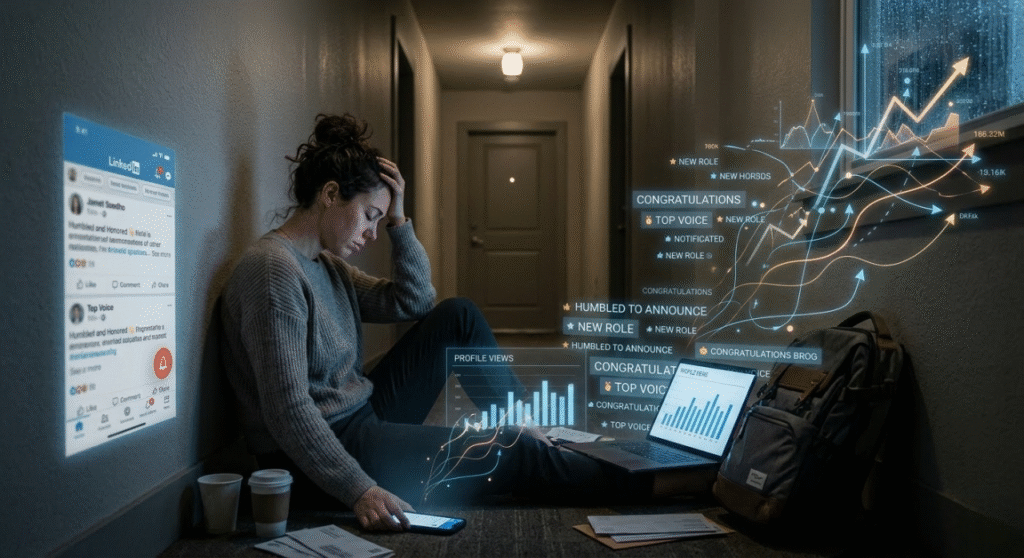
Building a professional brand in 2026 often feels like a full-time job on top of your actual full-time job. We scroll through a feed of “humbled and honored” announcements, 5:00 AM routines, and perfectly packaged pivot stories. But beneath the polished headshots and “Top Voice” badges lies a burgeoning mental health crisis.
The LinkedIn grind has transformed from a networking tool into a high-stakes arena for performative productivity, and the psychological bill is finally coming due. In this article, we’ll explore the hidden costs of this “success culture”—from performance-based self-esteem to the exhaustion of toxic positivity—and how you can reclaim your mental space.
The Rise of the LinkedIn Grind
LinkedIn was once a digital rolodex. Today, it is the epicenter of the LinkedIn grind, a culture that equates professional visibility with personal worth. As of 2026, the platform’s algorithm heavily favors “authentic” storytelling, which has ironically led to a surge in manufactured vulnerability.
Users feel a relentless pressure to:
Monetize every hobby: If you aren’t turning your weekend hike into a “5 Lessons This Trail Taught Me About Scalability” post, are you even growing?
Perform 24/7: The “always-on” nature of the LinkedIn grind means your professional identity never sleeps.
Sanitize failure: Obstacles are only allowed to be shared if they have already been overcome and tied with a neat, motivational bow.
This constant performance creates a “Hyper-Professionalized Self.” We no longer just do our jobs; we curate the image of doing our jobs. This leads to a cognitive load that the human brain wasn’t designed to carry—the weight of being a perpetual brand representative for ourselves.
1. Performance-Based Self-Esteem
One of the most insidious costs of the LinkedIn grind is the shift toward performance-based self-esteem. This occurs when your sense of value as a human being becomes inextricably linked to your professional output and the public validation it receives.
When you post a career milestone and it receives 500 likes, your brain releases a hit of dopamine. However, when a thoughtful post about a project falls flat, it can trigger a sense of professional inadequacy. You begin to view your “self” as a product that needs constant up-branding.
Psychologists call this “Contingent Self-Worth.” Unlike global self-esteem, which is a stable sense of being “good enough,” contingent self-worth is volatile. It rises with every promotion and crashes with every rejection. Because the LinkedIn grind rewards constant activity, those who step away for a mental health break often feel an intense sense of “Existential Guilt”—the fear that if they aren’t posting, they are disappearing.
2. The Trap of Toxic Positivity
LinkedIn is the kingdom of toxic positivity. It’s a space where “grinding” is a badge of honor and burnout is often rebranded as “hustle.” Research suggests that the suppression of negative emotions—like the frustration of a job hunt or the exhaustion of a toxic workplace—leads to increased chronic stress.
In the LinkedIn grind, there is little room for the “messy middle.” You see the “Before” (the struggle) and the “After” (the triumph), but the long, grueling “During” is often edited out. This creates a “Culture Dissonance,” where our digital feeds tell us everyone is winning, while our reality feels like a constant uphill battle.
Furthermore, the “Grindset” culture suggests that if you aren’t succeeding, you simply aren’t trying hard enough. This shifts the blame from systemic issues—like a difficult economy or a lack of childcare—onto the individual’s “mindset.” The result? A workforce that is not only exhausted but also feels deeply ashamed of its exhaustion.
3. The "Comparison Trap" and Digital Dysmorphia
On Instagram, we compare our bodies; on LinkedIn, we compare our careers. This “Professional Dysmorphia” makes us feel like we are falling behind an imaginary pace set by the top 1% of achievers.
The Age Factor: Seeing a “30 Under 30” list when you’re 35 and still “finding yourself” can trigger a profound sense of failure.
The Title Trap: We compare our internal struggles with everyone else’s external highlight reel.
The Skill-Gap Anxiety: Seeing others post about mastering AI, quantum computing, and five new languages in a weekend makes us feel perpetually obsolete.
The LinkedIn grind forces us to look at our peers not as collaborators, but as benchmarks we haven’t quite hit yet. This erodes the very “community” the platform claims to build, replacing camaraderie with a quiet, simmering envy.
4. The Erosion of the "Private Self"
When you are constantly looking for “content” in your daily life, you stop living your life and start documenting it for the LinkedIn grind. This erosion of the private self means that even moments of rest are hijacked by the thought, “How can I frame this for my network?”
Psychological studies show that this prevents true “disconnection.” The “Default Mode Network” of the brain—the part responsible for creativity and self-reflection—needs downtime to function. If your brain is always scanning for professional insights, you never truly enter a state of deep rest.
Moreover, this blur between the personal and professional leads to “Identity Fusion.” When your personality is your brand, any criticism of your work feels like a direct attack on your soul. This makes professional feedback harder to process and heightens the stakes of every interaction.
5. The Algorithm and the "Attention Economy"
We must acknowledge that the LinkedIn grind isn’t just a personal choice; it’s a design feature. Algorithms are engineered to keep us engaged, often by surfacing content that triggers strong emotional reactions—fear of missing out (FOMO), indignation, or extreme inspiration.
This creates an “Attention Arms Race.” To get noticed, users must become more provocative, more “vulnerable,” or more extreme in their productivity claims. This cycle is exhausting for creators and demoralizing for consumers. It turns professional networking into a spectator sport where the loudest voices win, regardless of the quality of their insights.
6. The Intellectual Fatigue of Personal Branding
Beyond the emotional toll, the LinkedIn grind demands an immense amount of intellectual energy. In 2026, experts are expected to be multi-channel publishers. You are no longer just an engineer, a marketer, or an executive; you are a content strategist.
This requirement leads to “Context Switching” fatigue. Moving from deep work on a complex project to drafting a catchy, SEO-friendly LinkedIn post requires a massive shift in cognitive gears. Over time, this decreases the quality of the actual work being done. When we prioritize the description of the work over the execution of the work, the industry as a whole suffers from a thinning of expertise.
7. Reclaiming the Meaning of Ambition
We have reached a point where ambition is often confused with visibility. True ambition is the drive to master a craft, solve a problem, or lead a team effectively. The LinkedIn grind redefines it as the drive to be seen mastering a craft.
To break this cycle, we must redefine what success looks like outside of a digital feed. Success might be leaving work at 5:00 PM to spend time with family. It might be completing a project that is so proprietary and complex that you can never post about it. It might even be staying in the same role for five years because you genuinely enjoy the work and the people.
Breaking Free: How to De-Link Your Worth from the Feed
If the LinkedIn grind is taking a toll on your mental health, it’s time to set boundaries. Here is how to navigate the platform without losing your mind:
Audit Your Feed
Unfollow or “Mute” accounts that make you feel inadequate. If someone’s “hustle porn” or constant humble-bragging triggers your anxiety, remove them from your digital environment. Your feed should be a source of information, not a source of inflammation.
Set “Consumption” Limits
Treat LinkedIn like a tool, not a social destination. Schedule 15 minutes a day for networking, then close the tab. Avoid “doomscrolling” the feed before bed or first thing in the morning, as this sets a tone of inadequacy for your entire day.
Practice “Invisible” Success
Not every win needs a post. Practice enjoying professional milestones privately or sharing them only with a close circle of mentors and friends. This reinforces the idea that your success is for you, not for public consumption. When you stop seeking external validation for every small victory, your internal confidence begins to stabilize.
Embrace the “Messy Middle”
If you do choose to post, try being genuinely honest—without the motivational ending. Sometimes work is just hard, and that’s okay. Normalizing the struggle helps break the cycle of the LinkedIn grind for everyone.
Rediscover Hobbies Without a ROI
Do something that will never be on your resume. Paint a picture you’ll never sell. Run a race you’ll never post about. Engaging in activities that have zero “Return on Investment” (ROI) is the ultimate rebellion against a culture that demands you monetize your existence.
You Are Not Your Job Title
In the hyper-connected world of 2026, the LinkedIn grind can feel inescapable. But it is important to remember that the platform is a filtered, curated, and often exaggerated version of reality. Your worth is not measured in “impressions,” and your value as a person exists entirely independent of your resume.
The most successful people aren’t necessarily those with the most followers; they are the ones who have the mental clarity to step away from the screen and enjoy the life they’ve worked so hard to build. Success is not a status update; it is the freedom to be yourself when the cameras—and the algorithms—are finally turned off.