



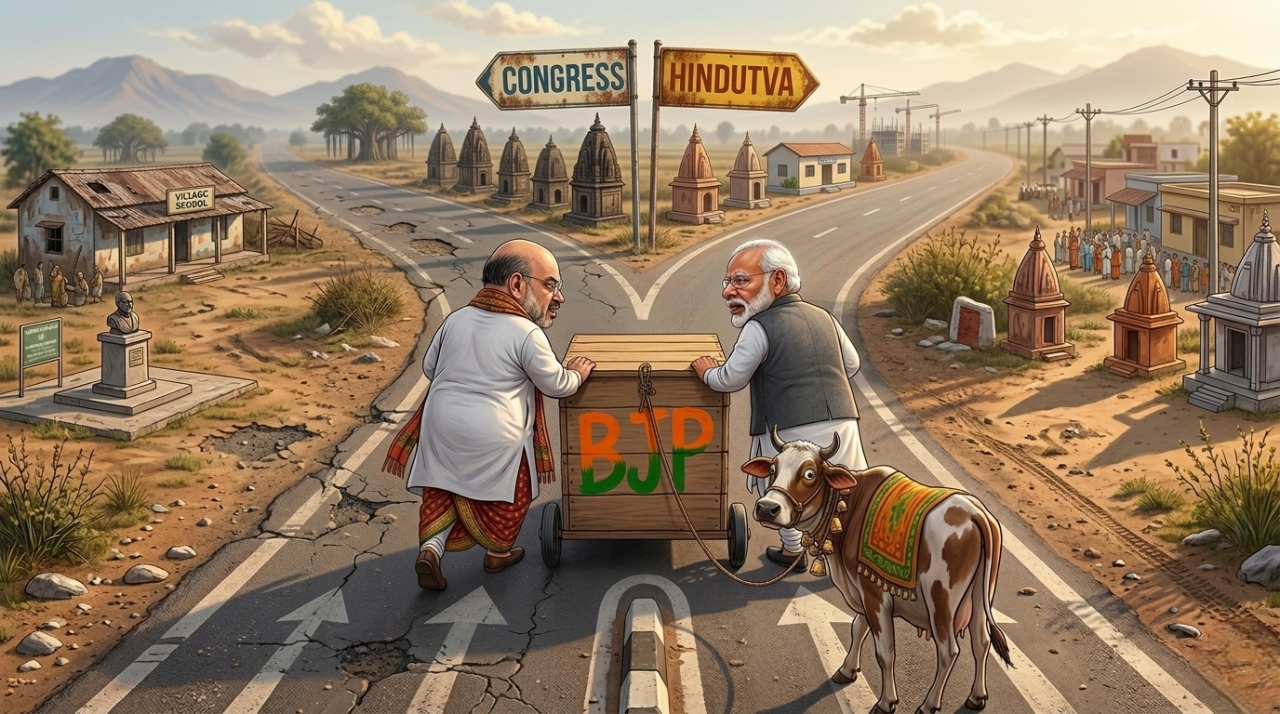
In the vibrant theater of Indian politics, the script has taken a turn so recursive that even the most seasoned critics are checking their programs. For years, the Bharatiya Janata Party (BJP) positioned itself as the antithesis of the Indian National Congress. It promised a “Party with a Difference,” a cadre-based, ideologically driven alternative to what it called the corrupt, person-centric, and populist “High Command” culture of the Grand Old Party.
Fast forward to 2026, and a curious transformation is underway. If you squint your eyes at the current political horizon, the distinction between the two giants is becoming as blurry as a monsoon evening. From the mass induction of “defectors” to the adoption of massive welfare schemes and the “domestication” of the fourth estate, the BJP increasingly appears to be navigating the very path it once claimed led to national ruin. Is this a strategic evolution, or is the party suffering from an ideological identity crisis?
The "Congress-Mukt Bharat" Paradox: Importing the Opposition
The most visible sign of this “Congress-ification” is the party’s roster. The slogan “Congress-Mukt Bharat” (Congress-free India) was intended to mean a country free of Congress ideology. Instead, it seems to have been interpreted as “a BJP full of Congressmen.”
In a twist of irony that would make a satirist weep, the BJP has spent the last decade vacuuming up hundreds of former Congress MLAs, MPs, and local heavyweights. While this has certainly weakened the Congress structurally, it has turned the BJP into a sprawling “catch-all” tent. Critics argue that the “washing machine” effect—where a leader’s past legal troubles miraculously evaporate upon donning a saffron scarf—is a direct page from the old Congress playbook of using power to consolidate political loyalty.
The result? In many states, the “BJP government” is essentially the “Old Congress” operating under a different flag. This has left the original, ideologically committed BJP cadre—those raised on the values of the RSS—feeling like strangers in their own home, watching as the “High Command” culture they once mocked becomes the new standard operating procedure.
The Rise of the Saffron "High Command"
Centralization of power was once the hallmark of the Indira Gandhi era—a period the BJP correctly identifies as a low point for democratic decentralization. Yet, in the current era, the “High Command” culture has made a grand comeback.
The BJP was historically a party of collective leadership (think the Vajpayee-Advani-Joshi triumvirate). Today, the party is unapologetically person-centric. From the selection of obscure Chief Ministers in the states to the minute details of local ticket distribution, the decision-making process has moved from the party organizational desks to a very narrow top-tier leadership. This centralization ensures efficiency, yes, but it also mirrors the “One Leader, One Party” model that the BJP spent decades warning the nation against. When the party becomes synonymous with a single face, the organizational depth it once bragged about begins to look more like a fan club.
Welfare Politics: Socialism with Better Apps
If the old Congress was criticized for its “socialist doles,” the modern BJP has mastered the art of “Digital Populism.” Under the banner of Sabka Saath, Sabka Vikas, the government has pivoted toward a welfare model that even the most ardent Leftists would recognize.
From PM-KISAN’s direct cash transfers to the massive distribution of free food grains to 800 million people, the BJP has embraced state-led welfare with a zeal that would make the architects of the 1970s “Garibi Hatao” campaign proud. While the BJP argues that Direct Benefit Transfer (DBT) makes this “empowerment” rather than “entitlement,” the political outcome is the same: the creation of a “Labharthi” (beneficiary) vote bank that looks to the central leader as the ultimate provider. The economic right-wing, which once looked to the BJP for market reforms and privatization, now finds itself watching a government that spends more on subsidies than any “socialist” predecessor ever dared.
The Institutional Squeeze: UGC and "Leftist" Social Justice
Perhaps the most surprising shift is the party’s recent foray into identity-based institutional regulation. The UGC (Promotion of Equity) Regulations, 2026, have become a flashpoint for this debate. By creating hyper-specific complaint mechanisms for SC, ST, and OBC students while omitting similar safeguards for the general category, the BJP has stepped squarely into the arena of “identity politics” that it once labeled as “divisive” and “minority appeasement.”
To the casual observer, this looks like a move to “out-Left the Left.” By adopting the language of social justice and systemic equity, the party is clearly attempting to bridge the gap with marginalized communities. However, in doing so, it risks alienating its traditional core base, which views these measures as a betrayal of the meritocratic, “Hindutva-as-a-unified-whole” promise. The Supreme Court’s recent stay on these regulations only highlights the confusion: is the government trying to decolonize education, or is it just building a more complicated bureaucracy to control it?
The "Hospitality" of the State: Journalists and House Arrests
Nothing says “Old School Governance” like a complicated relationship with the press. The BJP has always been vocal about the horrors of the 1975 Emergency, yet the modern era has seen a peculiar rise in “creative” law enforcement against the media.
Instead of an outright ban on news (which is so last century), the current trend involves a more “intimate” approach: the morning raid followed by the “preventive detention” or “house arrest” of journalists and activists. Whether it’s the use of the UAPA (anti-terror law) or investigations into funding sources, the goal remains the same—to ensure that the “correct” narrative is the only one in the air.
Critics find it darkly humorous that the very party that commemorates “Black Day” (the anniversary of the Emergency) is now accused by international watchdogs of using the state machinery to silence dissenting voices. If a journalist is kept at home under “supervision” for their reporting, does it matter if the order came from a “Saffron” high command or a “Khadi” one? The iron hand, it seems, just prefers a different colored glove these days.
The Crossroads of 2026
The BJP is currently a party at war with its own success. To become the dominant force in Indian politics, it has had to become everything to everyone. In the process, it has absorbed the Congress’s members, adopted its welfare strategies, centralized its power structure, and refined its methods of managing dissent.
The confusion is palpable:
Is it Hindutva? Yes, but a Hindutva that is increasingly mediated through the state’s welfare machinery.
Is it a Cadre Party? Yes, but a cadre that often has to take orders from a former Congress rival.
Is it Pro-Market? Only when the market doesn’t interfere with the next election’s populist requirements.
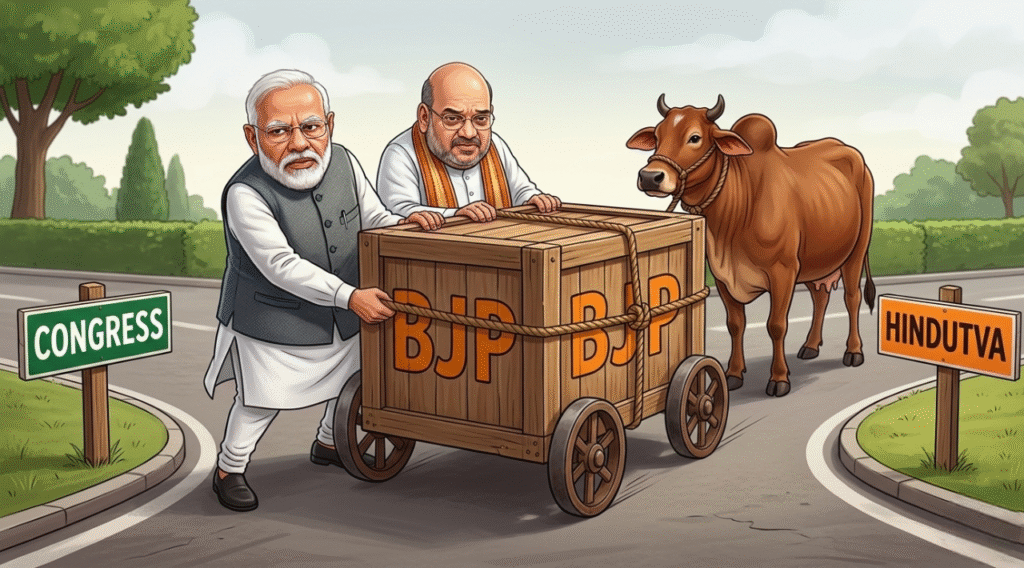
As the party pulls its “BJP” box down the road, it finds itself at a literal crossroads. One sign points toward a return to its original, disciplined, and decentralized roots. The other points toward the comfortable, well-worn path of the “Old Congress”—a path of centralization, personality cults, and state-led populism.
For now, the BJP seems content to walk down the middle, dragging a cow for symbolism while checking the GPS of a Congress-designed map. Whether this “Saffron-washed” version of the old system can survive the weight of its own contradictions is the question that will define the next decade of Indian democracy.