




We are often told that “the truth will set you free.” In the context of a career, we imagine that achieving total clarity about our goals, our strengths, and our missteps will feel like a sudden weight being lifted from our shoulders. We envision a “eureka” moment where the path forward glows with neon signs, and every doubt evaporates.
However, in the high-pressure professional environment of 2026, the reality is far messier. The process of gaining clarity is not a gentle sunrise; it is more like turning on a bright fluorescent light in a room you haven’t cleaned in years. Before you can enjoy the benefits of professional clarity, you must first endure the acute discomfort of seeing exactly what is broken, what is missing, and what you’ve been avoiding.
1. The Paradox of Choice vs. The Burden of Truth
The primary reason clarity feels uncomfortable is that it eliminates the “comfort of the vague.” As long as your career goals are blurry, you are protected from the pain of failure. If you haven’t defined exactly what success looks like, you can never truly fail to reach it.
The Discomfort: When you gain clarity, you lose your excuses. You can no longer blame “the economy” or “bad luck” if you have clearly defined that you are in the wrong role for your skillset. Clarity forces a confrontation with reality that most of us are psychologically wired to avoid.
2. The Five Pillars of Professional Clarity
To reach the stage where you can harvest the benefits of professional clarity, you must first navigate these five uncomfortable realizations:
Pillar 1: Honest Self-Assessment
This involves looking past your resume and into your actual daily output. It’s the discomfort of admitting that while you are good at your job, you don’t actually enjoy it.
Pillar 2: Identifying “Sunk Costs”
Clarity often reveals that the three years you spent on a specific certification or the five years you spent in a particular industry are no longer serving you. Admitting that you need to pivot feels like admitting you “wasted” time.
Pillar 3: Confronting Performance Gaps
One of the major benefits of professional clarity is knowing exactly where you need to improve. However, the initial sight of your own weaknesses can be bruising to the ego.
Pillar 4: Defining Non-Negotiables
Clarity requires you to say “no” to opportunities that don’t fit your path. Saying no to a high-paying role because it compromises your values is incredibly uncomfortable in the short term.
Pillar 5: Social Realignment
As you get clear on your direction, you may realize that your current professional circle doesn’t share your trajectory. Outgrowing your network is a lonely but necessary phase of growth.
3. Comparison: The Fog of Ambiguity vs. The Sharpness of Clarity
| Feature | The Fog of Ambiguity | The Sharpness of Clarity |
| Decision Making | Reactive and based on external pressure. | Proactive and based on internal values. |
| Energy Levels | Constant low-level anxiety and burnout. | Focused intensity and “flow” states. |
| Feedback | Taken personally as a threat. | Taken objectively as a data point. |
| Growth | Accidental and inconsistent. | Targeted and exponential. |
| The “Feeling” | “Safe” but stagnant. | “Scary” but liberating. |
4. Why the Human Brain Prefers a "Known Hell"
Neurologically, the brain is designed for survival, not fulfillment. To your amygdala, a mediocre job you understand is safer than a brilliant career you haven’t started yet. This is why we resist the benefits of professional clarity.
When you start to get clear on a big career change, your brain interprets the change as a threat. The “uncomfortability” you feel is literally your nervous system trying to pull you back into the “Known Hell” of your current situation because it is predictable.
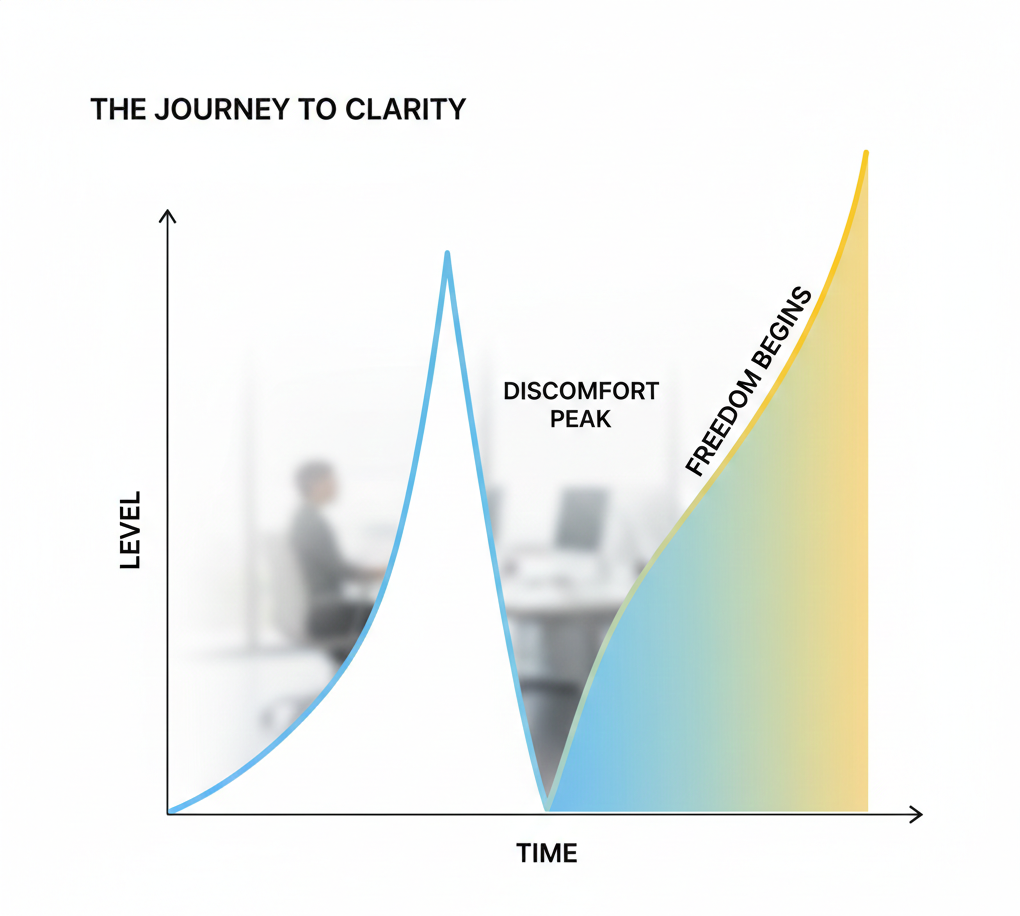
5. The "Messy Middle": Navigating the Transition
Once you have the clarity, you enter the “Messy Middle.” This is the period after you’ve realized you need to change, but before the change has yielded results.
The Strategy: During this phase, lean into the benefits of professional clarity as your North Star. Remind yourself that the discomfort is proof of progress. If you weren’t uncomfortable, you wouldn’t be growing; you would be coasting.
6. The 24-Hour Rule for Emotional Clarity
Clarity isn’t just about logic; it’s about emotional intelligence. When you receive a piece of information that challenges your career path, the initial “clarity” is often wrapped in anger or defensiveness.
How to Avoid This: Wait 24 hours before making a decision based on new clarity. Allow the “uncomfortability” to settle. Once the emotional static clears, you can see the benefits of professional clarity without the distortion of your ego’s defensive response.
7. Strategic Pruning: Making Room for Growth
In gardening, you must cut back healthy branches to allow the plant to produce more fruit. Professional clarity acts as the shears.
The Reality: Pruning feels like loss. You are “cutting” projects, clients, or roles that are “fine” to make room for what is “great.” This is one of the most significant benefits of professional clarity, but it requires a stomach for short-term loss.
8. The Freedom on the Other Side
Once the initial shock of clarity wears off, a transformation occurs. You begin to experience the true benefits of professional clarity:
Decision Fatigue Vanishes: Because you know your “Yes” and your “No,” you no longer spend hours agonizing over choices.
Confidence Increases: Confidence is simply the absence of self-doubt. When you are clear, doubt has no place to hide.
Attraction of Opportunity: When you are clear about who you are and what you do, the right people and opportunities find you more easily.
9. Tactical Framework: The Clarity Audit
Sometimes we are too close to the picture to see the frame. A mentor provides an external perspective that can accelerate the process. While their honesty might sting—adding to the temporary discomfort—it is the fastest way to unlock the long-term benefits of professional clarity.
10. The Role of Mentorship in Finding Clarity
Sometimes we are too close to the picture to see the frame. A mentor provides an external perspective that can accelerate the process. While their honesty might sting—adding to the temporary discomfort—it is the fastest way to unlock the long-term benefits of professional clarity.
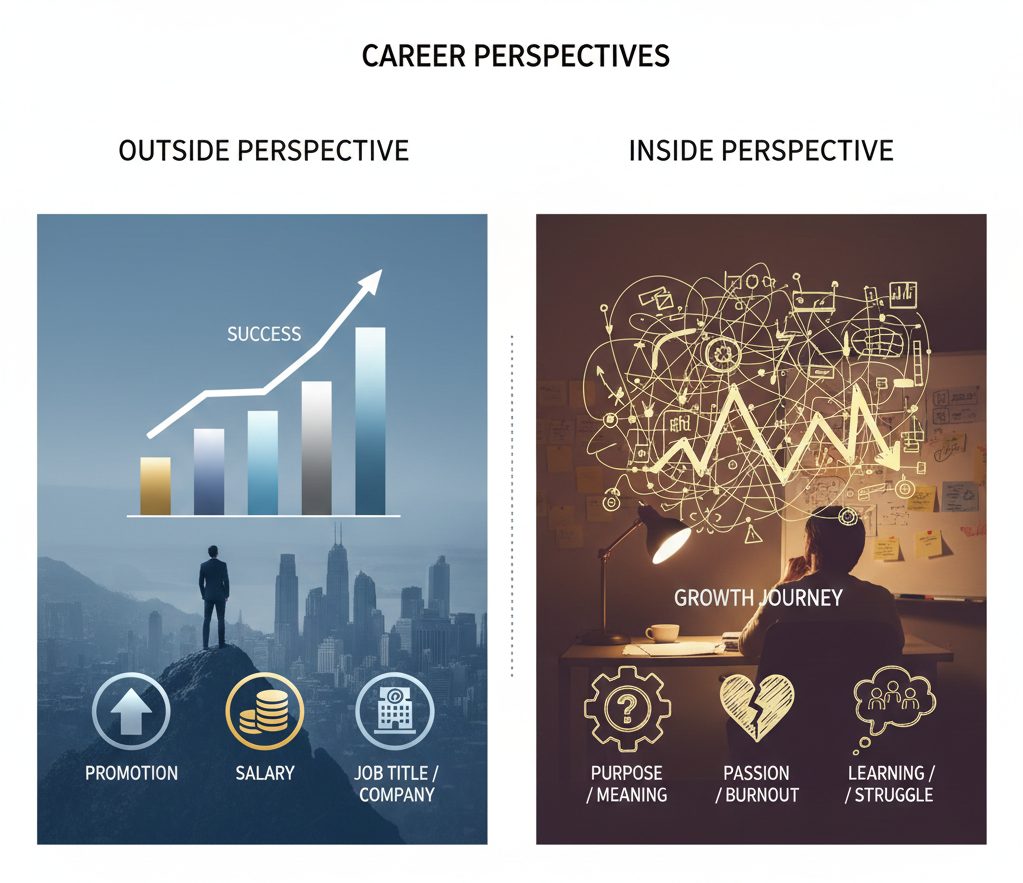
Embracing the Burn
Clarity is like a workout. The “uncomfortability” is the muscle fibers tearing; the “freedom” is the strength that follows. If you are currently feeling overwhelmed by the realization that your career needs to change, or that you’ve been playing small, do not turn away.
The benefits of professional clarity are only accessible to those willing to walk through the fire of self-truth. Stop settling for the “comfortable fog” of a career that doesn’t fit. Lean into the discomfort, ask the hard questions, and trust that the freedom waiting for you on the other side is worth every bit of the initial sting.
FAQ
Q: How do I know if I’m seeking clarity or just overthinking? A: Overthinking leads to circular thoughts and anxiety without action. True clarity leads to a decision, even if that decision is “I need more data.” If you aren’t moving toward an action, you are overthinking.
Q: Can I have too much clarity? A: You can have too much rigidity, but not too much clarity. Clarity allows for flexibility because you know your core values so well that you can adapt your tactics without losing your way.
Q: What is the biggest of all the benefits of professional clarity? A: Time. When you are clear, you stop wasting time on the wrong people, the wrong projects, and the wrong worries. You effectively “buy back” years of your life.
Q: Does clarity mean I won’t have any more stress? A: No, but it changes the type of stress. You move from “Anxious Stress” (worrying about what to do) to “Creative Stress” (figuring out how to do what you’ve already decided on). The latter is far more productive and less draining.